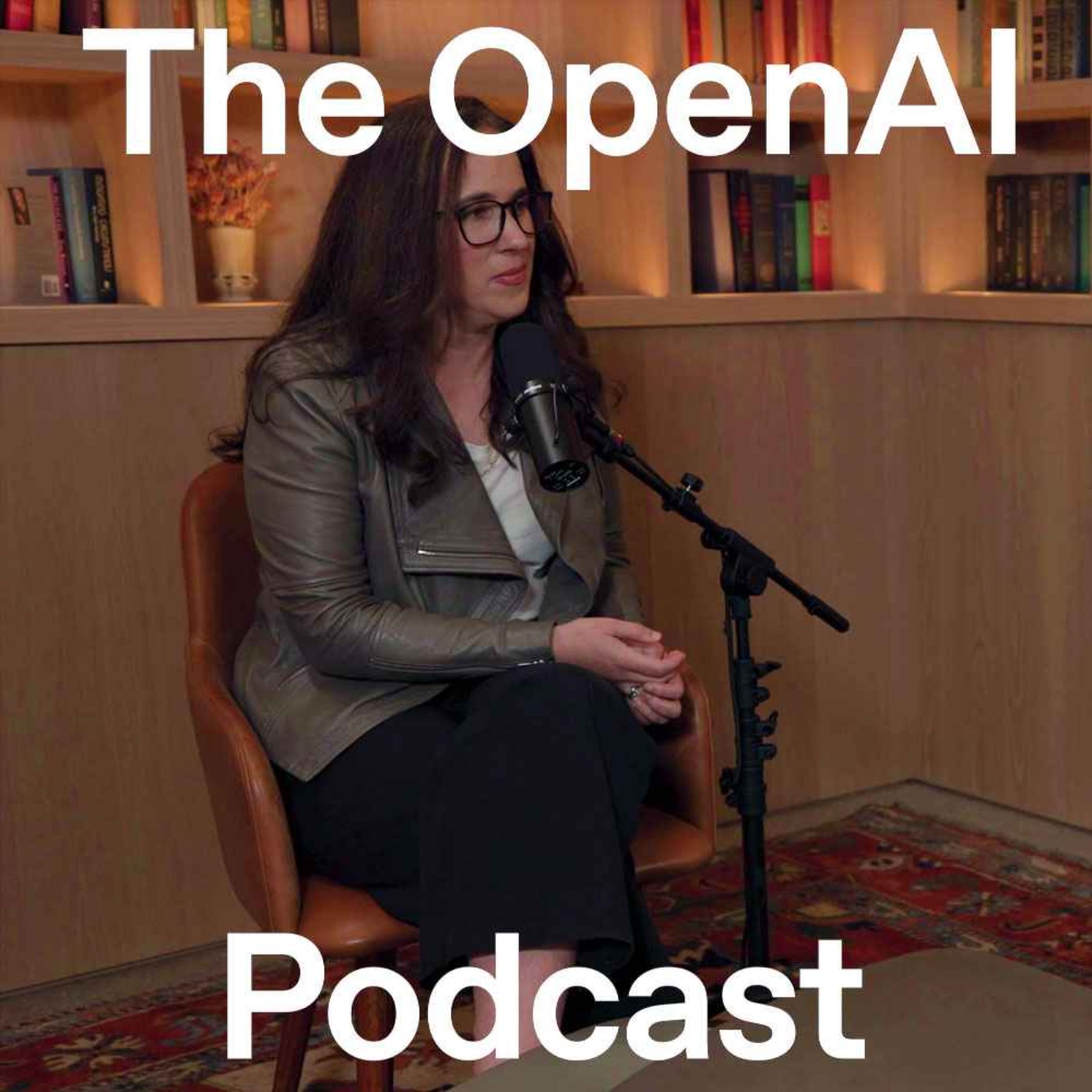
OpenAI Podcast · 2025-07-30
PodcastYouTubeHow AI is Transforming Education (OpenAI Podcast Ep. 4)
Hosts: Andrew Maine
Guests: Leah Belsky, Yabsera, Alaap
Why it matters
Belsky claims ChatGPT is 'the world's largest learning platform' at 600M users, with learning a top use case
Key claims
- Belsky claims ChatGPT is 'the world's largest learning platform' at 600M users, with learning a top use case
- OpenAI for Countries program: Estonia was first to reach out, with ministries globally seeking to deploy AI as core education infrastructure
- Study Mode launched to act as a Socratic tutor—personalized, contextual, with quizzes and follow-ups—developed after India trip revealed high household spending on tutors
- Belsky publicly distances from AI detectors, calling them 'terrible' and saying they wrongly accused honest students
Radar summary
Summary
OpenAI's head of education, Leah Belsky, frames ChatGPT as the world's largest learning platform, citing 600 million users and learning as a top use case, and outlines OpenAI's education strategy spanning consumer learning, campus deployments, and country-level partnerships. She describes a new product called Study Mode—launched after research in India showing families spend heavily on tutors—designed to move ChatGPT from an answer machine to a Socratic tutor that personalizes responses, quizzes learners, and scaffolds knowledge.
Belsky argues AI can equalize access to high-quality tutoring, especially for students without private tutors, and shares a personal anecdote about her dyslexic daughter using Advanced Voice Mode to independently access current events. She also addresses backlash: AI detectors were ineffective and harmed honest students, and institutions that initially banned ChatGPT reversed course after teachers pushed back. Both Belsky and host Andrew Maine argue coding remains a core literacy even as 'vibe coding' lowers the barrier, and that workers who use AI are significantly more productive—with Belsky citing data that 7 in 10 employers prefer candidates with AI skills over those with up to 10 years of experience.
Two student guests—Yabsera (USC, entering a business analytics master's) and Alaap (Berkeley, EECS sophomore)—share their own patterns: using ChatGPT for brainstorming, coding help, deep research with constrained sources, and persona-based critique, while drawing back from passive social media use. They emphasize that professors are shifting assignments away from rote recall toward applied and open-ended work, and that Study Mode's back-and-forth questioning produced more rigorous learning than standard chat. Both predict a hybrid future where AI handles content delivery and humans focus on mentorship, ethics, and social capital.
- Belsky claims ChatGPT is 'the world's largest learning platform' at 600M users, with learning a top use case
- OpenAI for Countries program: Estonia was first to reach out, with ministries globally seeking to deploy AI as core education infrastructure
- Study Mode launched to act as a Socratic tutor—personalized, contextual, with quizzes and follow-ups—developed after India trip revealed high household spending on tutors
- Belsky publicly distances from AI detectors, calling them 'terrible' and saying they wrongly accused honest students
- Coding framed as a core literacy that becomes more, not less, important with vibe coding and AI code generation
- Workforce claim: '7 in 10 employers would rather hire someone with AI skills over someone who had up to 10 years of experience'
- Equal-access narrative: universities that buy campus-wide licenses show 'pride' in leveling access vs. financially-aided students buying their own
- Belsky argues Study Mode directly addresses 'brain rot' concerns by forcing struggle and feedback rather than answer-copying
Source material
Full source text
Hello, I'm Andrew Maine, and this is the OpenAI podcast.
Today, we're going to talk about chat GPT and education.
Does it cause brain rot?
Is chat GPT just a tool for cheating?
We're going to speak with Leah Belsky, head of education at OpenAI and a couple of students who are active users.
Chat GPT at this point is now the world's largest learning platform.
It allows you to kind of cut through the noise and do things that you actually enjoy.
Chat GPT was going to unlock the world for this girl, and I was not going to have to be worried in the same way.
When it comes to learning and exploring ideas, I asked chat GPT a lot of those questions.
Tell me about your journey to OpenAI.
I think ultimately, OpenAI is about a mission and about its people.
And so I'll tell you at least my story.
So I came to OpenAI after spending 15 years in the education space, starting at the World Bank and then at Coursera, focused on this mission of making education accessible to the world.
And I took on this job, Brad, our COO, he brought me into the office.
And I was wondering what the exact focus of education at OpenAI would be.
And he sat me down and he said, Leah, I want you to go after the moonshot.
We all have this dream that AI could improve human potential, that it could be an effective tutor and a companion for people throughout their lives.
Go after that dream and make sure that once we build that product, everyone in the world can have it.
And that's really been the North Star.
And I thought that was meaningful from the head of go to market, the head of revenue, to say, go after the biggest transformative moonshot so that the highest in hopes and dreams that we all have for AI and education can be realized.
That's pretty inspiring and hopeful, the idea of trying to make this widespread as possible.
How do you see basically global impact?
How are we going to see the effects of this around the world?
Well, first thing to say is like ChatGPT at this point is now the world's largest learning platform.
Learning is one of the top use cases on the platform.
At 600 million users, that means it is the world's learning destination.
And that means learning outside of the educational system.
I really see ChatGPT as a new frontier for learning.
But we also see that teachers are major adopters of the platform.
And they are using that both to get rid of the administrative burden of their own work, but also to bring it into their classroom.
What's been striking is to just see the global demand for ChatGPT.
So a few weeks ago, we launched a program called OpenAI for countries.
And we've had ministries all over the world reach out.
Estonia, the country of Estonia, was actually one of the first countries that reached out.
Well, Estonia makes sense.
Estonia makes sense.
They are the top of the world.
They have some of the best PISA scores.
They have an amazing educational system.
But they were the first to realize, wow, this is an opportunity to push students even further and to empower our teachers even further.
And after Estonia, it's been one country after another.
And what's interesting is that when the countries come to us, they're coming to us because they want to deploy AI as core infrastructure through their education system.
But they're also coming to us because they're feeling the impact of an economic transition.
And they're realizing that if they are going to be developing an AI-powered economy, they need to graduate a workforce that learns how to use AI.
And so it's not just about creating new AI courses.
They need to make sure that every student who leads their secondary school system has used AI as part of their class.
And so it's that dual focus of these countries.
They're looking to be economically competitive.
They want to build an AI-ready workforce.
They want to be successful in a new AI-powered economy.
And they want to improve their education system.
What are you hearing from educational partners and institutions?
So we're hearing a couple of things.
I think those that have made the investment feel a certain pride that they have equalized access to AI on their campuses.
They really believe that AI should be core infrastructure for the campus and that it should be open to everyone.
They're conscious that before introducing AI on many campuses, you'll find a situation where those who are not on financial aid will be buying access to the latest models and those who don't have access to resources will not.
So there's a pride in driving equal access.
I think their institutions are also hungry to engage with each other and collaborate and understand what are the top five or 10 ways in which faculty are using the tech and bringing it into the classroom.
The other type of feedback that we're getting, though, is that students are hesitant to use some of the school-provided AI.
And unless universities make a big point of telling students that we're not monitoring this tech, we're not looking at your conversations, students are hesitant to adopt it.
What's striking is that the generation of students that is in universities right now is the COVID generation.
They are used to having some of their first experiences with PacB about Zoom and Glueable Classroom and having teachers screaming at them or monitoring and telling them they're not doing that homework while they're all sitting at home going crazy.
And so they're hesitant about educational technology.
And universities are realizing that if they want to engage with students and help students learn in new ways with chat GPT, they need to build an actual trust with students.
Yeah, I mentioned this before, but I was frustrated because the AI detectors were terrible.
There were these AI detect-- one, I could show somebody how to write text that would be flagged as AI and also how to prompt a thing to avoid it.
And that just created this relationship that started off.
If you're using a bad tool like that, you take one or two students who didn't cheat and told their cheaters.
Yeah, in many institutions, I would say we got off onto the wrong foot with AI in the classroom.
Instead of trying to be explicit and establish clear policies on when students should use the tech and when they shouldn't, teachers hid from it.
We started with policing its use rather than actually sitting there and figuring out how do we actually want to redesign the way we assess students and the way we assign homework.
But I think we're moving beyond that point.
Yeah, I've been encouraged.
And we saw-- I remember when I was here, we had one school system that had a knee-jerk reaction.
It said we're banning it.
And it was like a few months later, they had enough teachers within there going, hey, no, this is a really good tool.
We know how to teach to this.
And they said, OK, we're going to reverse that now.
And that was-- it was very good to see energized teachers embrace this and say, OK, in wanting their students to understand they knew this was going to be part of the future.
Well, now there's study mode.
Could you talk a little about that?
So study mode is a product we just launched.
And it is intended to take-- really improve learning in chat GPT and take it from an experience that is just focused on giving answers to really guiding a student to get to the answers.
So study in study mode, chat GPT answers.
Socratically, it personalizes responses to the level of your learning.
It understands the context of what you're learning.
It asks great follow-up questions.
It asks if you want to have a quiz on the topic.
It encourages you to go deeper.
And ultimately, this is a first step to really leaning into this idea of chat GPT as a tutor.
So how did this come about?
Was there conversations with educators and parents about this?
So study mode actually came out of a trip that our team took in India, where they realized a few things.
One, they realized that in a place like India, families were spending a huge percentage of their per capita income on tutors and after school help.
They also realized that there was just a tremendous will and desire among young people to get to the next level.
And so we began this journey of what would it take to actually get chat GPT and turn chat GPT into an even better tutor than it already is.
And so we started by-- and this was my first experience building an AI product.
So we started actually building a schema informed by learning science and informed by pedagogical experts that said, how should chat GPT respond?
It's not just going to give answers, but it's going to actually help you learn.
And then we worked with open-- with experts around the world to gather what we call golden examples of how chat GPT would ideally respond.
Is the tone encouraging?
Does it encourage curiosity?
Does it cater a response to the level of a student's need?
And through that process of going back and forth and training the model, that's how study mode emerged.
And I would say we're super excited to see the feedback on this product out in the world, but it's also very much a beginning.
Yeah, it's a starting point.
It's a starting point.
We're really only in the early stages of pushing the way in which the model can respond in multimodal ways.
One day you could imagine asking study mode to give you samples of a biology assignment to explain organic chemistry and to pop up interactive diagrams or to nudge you.
Three weeks down the road, do you remember you told me that you wanted to ace this year's organic chemistry exam?
Shall we dig back into the topic now?
It could be proactive and really travel with you over time.
And I think over time, the hope is to get study mode to that point.
That'd be great.
Yeah, I can see that combined with spaced repetition, and you could have just a really good tool that doesn't just help you pass the test, but help you remember it for a long time.
And I think you touched about something there, which is that in certain households, they can afford to have private tutors.
Tutoring program's great.
And we talk about the differences in educational opportunities.
You can have a bunch of kids that go to the same school, but the parents that are able to have the kid go to a tutor are going to be in a situation where the child's going to have a higher chance of an outcome.
Now you see this as a leveler.
Look, I think the first place where AI is having a huge impact in education is not even in the classroom.
It's outside of the classroom, where it's equalizing access to what's really like adult support.
There are many students out in the world who don't have access to a quality teacher.
They don't have access to tutors.
They don't have access to parents who are going to sit down and help them.
And now with AI, they can have this companion who can encourage them, who can give feedback on their homework, on their writing, who can help them answer tough questions.
We formed a lab of student users of ChatGPT.
It's called ChatGPT Lab.
I think you're going to talk to a few of the students.
And one thing that really struck me is they said using AI gave them confidence.
And it got to them in place where formally they would feel stuck or they would feel discouraged.
One of the students told the story of being in the classroom as a computer science student.
And for many years, she would get stuck in her computer science courses.
And she started to give up.
She couldn't understand the textbooks.
But when she used ChatGPT out of school as a tutor, she started to feel like, oh, I can ask questions.
I can understand this.
I have confidence.
And maybe I can actually continue and move forward.
And so I think it's as much-- if you think about what tutors do in the world, they give you encouragement.
They give you a sense of confidence that I can and I want and I can move forward.
And then, of course, they deliver the content in contextual and personal ways.
I think ChatGPT can do all of these things.
So when it comes to workforce productivity, how does that work on a personal scale?
What advice would you give to people?
So all the recent data shows that workers who use AI in the workforce are incredibly more productive.
It's particularly true in fields like professional services and financial students.
But really, any graduate who leaves institution today needs to know how to use AI in their daily life.
And that will come in both when they're applying for jobs as well as when they start their new job.
And so one of the big reasons why institutions are now deploying AI as core infrastructure across campus is they want to make sure their students leave with those workforce skills.
The data shows that 7 in 10 employers would rather hire someone with AI skills over someone who had up to 10 years of experience in a given function.
I've seen that-- I run a firm where I help put together teams to work with companies who are trying to deploy AI.
And the thing that we look for in people we work with is basically AI skills.
Somebody has spent six months learning how to use this stuff.
I don't really care what their LinkedIn or actually their curriculum looked like.
I just want to know, have you been using it?
Can you use it?
Yeah.
Look, I think the other core literacy that's going to become important now is coding.
For a while, there was a moment where we thought all students need to learn coding.
And then I think there was a big focus on engineers.
But now with vibe coding and now that there are all sorts of tools that make coding easier, I think we're going to get to a place where every student should only learn how to use AI generally.
But they should learn to use AI to create, to create image, to create applications to write code.
And I think basic coding is going to become a core literacy.
That's going to be important as well.
Yeah.
I hear people go, why learn to code?
Because AI codes for you.
And it's like, why learn to read if books are full of text?
I was like, no, the world still runs on these things.
And I think, yeah, it's very valuable.
One of my colleagues, he does a lot of financial stuff.
And he's creating new calculators and building little tools for this all the time.
I build stuff for myself for learning and whatever.
And I already knew how to code.
But it just makes it so much easier.
And knowing what the code does is effective.
Yeah, absolutely.
So I'm of the view that as coding becomes something that's easier, the ability to understand code, to create it, and to bug it is going to become a core literacy.
That's going to become increasingly more important.
I think that's great advice.
I think just the more time people spend trying to use these tools, trying different things with these tools.
And one of the things I've heard that works really well is just meeting on a regular basis with other people, whether it's at a workplace, like have once a week or once a month to do together and talk about stuff, our students sharing what they've learned.
So there's been some sort of sensational headlines talking about how AI can cause brain rot when it comes to education.
Look, I hear you, and it's one of these questions I get asked every day.
AI is ultimately a tool.
And what matters most in education space is how that tool is used.
Learning takes struggle.
It takes working with information.
It takes processing it.
If students use AI as an answer machine, they're not going to learn.
And so I think that's what people are worried about.
And so part of our journey here is really to help students and educators use AI in ways that will expand critical thinking, that will expand creativity.
And you don't need to read complex studies to know that AI use in certain ways is positive or negative.
I think of my daughter.
She's learning long division right now.
It takes a certain amount of struggle.
There's some tears involved.
If I were to hand her a calculator and said, don't do the division problem, just put it into AI.
Are you going to learn long division?
She wouldn't.
But at the same time, down the road as she's learning advanced math, I anticipate I can give her that calculator and she'll be able to do math at a higher level than she otherwise would.
AI use is no different.
It needs to be used in a way that drives feedback, that gives people personal tutoring, that helps you ask and answer questions in different ways.
That's how we're going to advance learning.
Yeah, I read-- there was one study that just recently made the news.
And I actually sat down and I read it.
And I was saying, if you copy paste answers, you don't learn, which was just like, wow.
It's like, if I were training for a marathon and you said, like, hey, Leah, can I give you a scooter?
And for some of these training runs, you'd like take a scooter down the road.
I wouldn't get into more shape.
That was very similar to that study.
Yeah, and I think the frustrating things-- I think there really are important questions to be asked about this.
I do think that critical thinking skills, we have to think about how we develop these and how we pursue that.
I get a little frustrated that when I see-- again, I'm sure there's a real good defense of that study.
But I see studies like this is-- you're saying an obvious thing.
The thing we need to think about is, how do you actually use these tools?
How can you improve your critical thinking skills?
And I think that's going to be an open-end question we're going to have to keep asking ourselves.
Look, part of the reason why we created study mode, which is essentially a tutoring experience for students, is so students wouldn't have to learn how to prompt the model in ways that would give feedback or quiz or drive learning.
Instead, it would be a mode that you would enter where the model itself would push you and would guide you towards answers and personalize and give context and scaffold knowledge.
So we're on this journey to create an experience in chat GPT where a student doesn't have to know how to use it in certain ways.
And I think that's where you're going to really see the boundaries of learning being advanced.
I'm excited because I'm hearing anecdotal stories from parents where they'll-- well, supervised, but they'll let their kid start a conversation with chat GPT.
And he quickly realized that chat GPT has infinite patience to talk about frogs.
You can never exhaust it.
It'll talk about frogs forever.
And that budding herpetologist might all of a sudden realize that they really like talking about this, even though their parents don't.
One of the things that's magical about chat GPT is it's patient, infinitely so.
No question you ask chat GPT is ever stupid.
It will always respond.
It will always give you an honest, reasonable answer.
And half of learning is about feeling confident, inspired to learn.
One of the things we always said at Coursera is it's one thing to build amazing courses and amazing tech, but to really get a kid to learn, you need to have them feel like I can learn and I want to learn.
I think a lot of what AI is doing in the education space is giving people that scaffolding to have confidence that they can dive in and they can learn.
So one of the reasons I came to OpenAI was actually also connected to my daughter.
She is a dyslexic.
And for years, I would watch her brother come down in the morning and read the newspaper.
And I would think to myself and think, how is this brilliant little girl going to actually learn how to access the world?
How is she going to learn that about current events?
And the summer before I joined OpenAI, we launched Advanced Voice Mode.
And I remember handing her the phone.
And I said, Zoe, why don't you try talking with chat GPT?
And she said, hey, chat GPT, my mom is worried that I'm not going to learn about current events because I can't read the newspaper like my brother.
Can you tell me what's going on in the world?
And it was so poignant as I remember chat GPT responding and saying, sure, Zoe, what are you interested in?
What do you want to learn about in the world today?
And from there, the conversation went on.
And they were talking about all her interests in space and robots.
And I realized in that moment that chat GPT was going to unlock the world for this girl.
And I was not going to have to be worried in the same way.
That's powerful.
I'm excited to see how it helps with issues like that, accessibility issues.
And I think that it's going to be interesting to see where we are a few years from now.
Leah, thank you so much for talking with me.
This has been very interesting.
I'm excited to see where these things go next.
Awesome.
Great talking to you, Andrew.
I'd also like to know a little bit more about you both too.
So Yabi, could you tell me what you're studying right now?
Yeah.
So I actually just finished up my undergraduate degree in communication at USC.
And then I'm going to enter the first semester of my master's program in business analytics, also at USC.
OK, cool.
So why did you want to choose that?
Initially, when I came to college, I wasn't really sure the subject matter I wanted to study.
So I took a lot of time to take GE courses to explore.
And then through there, I think I liked the more of the human component of research and theory.
And I found that communication was a really good major to explore that through.
And then throughout my college career, I started taking a lot of stat classes and then gave me the basis for analytical thinking.
And I really wanted to add that on.
So I added a data science minor.
And then having that creative and analytical component come together, I think it led me to business analytics.
It's a very interesting combination there.
That's pretty cool the way that came about.
So Alop, tell us what you're studying.
Yeah, I'm studying electrical engineering and computer science at Berkeley.
I'm a rising sophomore.
What brought you into those fields?
I think growing up, I grew up in the Bay Area.
So I've been exposed to a lot of tech around me.
And I'm also a really hands-on guy.
I like fidgeting with circuits or playing around with code.
And I really like finding solutions to some issues that I see.
And I found that one of my favorite ways to do that was through code and through hardware engineering.
So I thought this would be a combination of the two.
Did you like to build things when you were younger?
Yeah, yeah, definitely.
I build a solar power car.
Of course.
Yeah, just like a small one.
And then I built a big one later.
Yeah, obviously.
But yeah, just anything I could just really see in person and visualize.
So you guys are both pretty forward thinking.
Could you tell me what was your first big aha moment with AI?
Any kind of AI in general?
I remember I was a junior in high school.
And this buzz of, oh, have you heard of chat GBT?
It started going around.
And that was like-- obviously, AI had existed before.
I had witnessed the ASEMO robot.
I don't know if you've heard of that.
But yeah, so humanoids.
But really seeing an AI that I could actually use and interact with was chat GBT.
And we're all huddling around my computer.
And I just made an account with OpenAI.
And I had an assignment on how to write my To Kill a Mockingbird essay.
And I was like, if it can really do anything, let's see how it writes.
And boom, it wrote me a full To Kill a Mockingbird essay.
I did not use it.
But it was definitely cool to see in just a moment that I really remember.
I want to ask you a little bit more about that.
So how about you?
I think for me, it was honestly funny.
Because I think a lot of people started off with an academic or study use case for it.
But then I think when I stumbled across from it, I remember I was a sophomore, my first semester of sophomore year in college.
And I saw the social media posts about how you can use chat GBT for certain-- write a story for me.
And so I think my first prompt to it was to write fan fiction, which is really funny.
And it was just a random use case.
I remember showing my roommates.
And they all thought it was pretty stupid, honestly.
And so I think it was just a lot of mundane random use cases.
And then I think it was later on that I actually started using it academically, specifically, when I started doing more coding-oriented classes.
But I think that aha moment for me is the fact that you can use it for day-to-day tasks, unless-- so for educational research.
I can't let this drop.
You mentioned fan fiction.
What fan fiction?
So just to give context, I feel like when I was younger, I was most-- There's no judgment.
You don't have to context.
There's no judgment here.
Thank you.
This feels like chat GBT.
Don't say that, too.
I see what you're saying.
That's great.
So yeah, I think there was a lot of different kind of outlandish fan fictions going on.
And I think one of the communities that I thought was pretty funny was the Shrek fan fiction community.
Sorry.
I'm sorry.
I thought you said the Shrek fan fiction community.
Could you say this again?
Yes, the Shrek fan fiction community.
OK, so you did say that.
Yeah, and so I think-- I don't know why that was the top of mind kind of trope that I wanted to prompt.
And back then, it was super early.
So it wasn't like the outputs weren't as good.
But I feel like this could definitely be on one of those platforms that they write fan fiction all the time.
It's interesting because part of the value of fan fiction is it's a way for fans to participate.
And the ad can produce something that's cool that can kind of appeal to you.
And you showed your friends and they were like, what?
They're like, this is stupid.
But for you, it created a neat moment.
I think that's a lot of things we forget.
I write, and I love to write.
Part of the writing experience is the writing.
And people are like, oh, you worked at Open Air.
You can just chat GPT.
That's like asking somebody to learn to play the electric guitar.
Are you just going to play electric guitar music all the time instead of actually playing the guitar?
No, I learned to write to write to do these things.
So I think that kind of gets overlooked.
But that where you can say, hey, what about this scenario?
And Shrek fan fiction is like the most sweet and innocent thing I think I possibly could have heard.
So how would you say your professors have been adapting?
I think in terms of actual assignments and work, I feel like the way I'm feeling about it is similar to how I felt when we were younger in elementary school and we're transitioning between doing hand division to using calculators to take on bigger tasks, like you said.
So I feel like it's that kind of transitional period where it's I think a lot less like automated tasks.
So I feel like in my communication courses, I'm seeing a lot less like define this term kind of question and more about how do you apply this term?
What does this mean in a bigger context?
So I feel like there's a lot more focus on meaning and intentionality as opposed to kind of more basic understanding.
And I think a lot of test taking forms are actually more open format than I thought they would be.
And because of that, the questions have also shifted to ask more of questions that could be extrapolated to bigger meanings as opposed to the typical define this term.
So I feel like that's how I've seen a change.
Yeah, I've actually noticed that in my CS classes, some professors, obviously they want us to not use it for these like simple homework assignments that are just like check for-- check to see if you actually remember the concept.
But for bigger projects, we actually got two tracks we could take.
One is with using AI and one is without using AI.
And I thought it was really interesting that the professor is kind of greeting this new concept and adapting to it.
And the professor said with AI, we're going to give you a bit of a harder assignment and we're going to push you more.
And you're going to have to write a reflection on what AI gave you so that you also get the concepts that AI would tell you.
But with the non-AI, you would kind of do a more traditional project.
But with AI, you could like push it much further.
So it was great that the professor was allowing you to choose between the two.
Which did you choose?
I chose non-AI.
OK.
Yeah, I know a lot of people who did choose AI.
Why did you choose non-AI?
I think that for me, I wasn't the most technically sound with the concept that the project was about.
And I remember that I had a few features that I myself wanted to implement in this kind of mini game.
But with AI, it was like you can ask it to brainstorm and help you get features and you can implement those with AI.
But I kind of knew what I wanted to do from the get go.
And because I already had my ideas, I use AI a lot for brainstorming.
But because I already had my ideas, I was like, oh, I might as well just really just focus on implementing the ideas that I had already come up with.
That's a thing that comes up a lot because I think some professors, they want the students to learn the fundamentals, which is important because if you learn Python, you really need to learn Python.
And I think it's going to be helpful for even for decades to come.
You need to have people who understand how these things work.
But I've seen some programs where they're not even teaching them how to use AI for code generation, which to me sounds like malpractice.
Which again, just that's my take on that.
But I think that I like the idea that there's different courses.
And the idea that if you're going to use AI, then great, you have to do bigger challenges.
And I've had people ask me about this.
What do we do that people can use to add GPT?
I'm like, have students do bigger projects.
Where they would have done a book report before, have them make a music video.
Just make bigger things and do more.
I think there are valid concerns when people are looking at something that's going to change the way that we work and trying to figure out the outcome.
And so I understand some of the hesitation there.
And I do think that critical thinking skills are important.
And I think this technology is trying to adapt to that.
Because if it's just another thing that people copy paste from them, like, yeah, you're not going to learn.
So OpenAI is rolling out a new feature, Study to Chat GPT, which seems to be kind of very interesting approach with that.
Have you guys tried this?
Yeah.
How would you describe it?
I would say that study mode is challenging.
And it forces the user to actually challenge themselves with any sort of content.
So I myself, when I tried it, I asked it to teach me about AI.
And I also tried this with a regular chat mode.
And it just gave me a big list of, oh, AI is this.
There's this type of learning, this type of learning.
And when I asked study mode, it actually just didn't even answer my question and gave me three questions to understand what I really wanted.
And it said, do you have a specific topic that you really want to get into?
How much do you know about this?
What are you doing right now?
And I got it to a specific topic, which is fine tuning.
And it really broke it down one by one.
And I think the biggest thing about study mode is that it doesn't just assume that you remember it and move on.
Maybe after a few minutes, it'll go back and say, oh, here's a little mental check, a little sanity check.
Do you remember this?
And you'll have to answer that again.
Because in our brains, that's what's really forming those connections, our neural connections, and actually helping us remember these concepts.
And I think that study mode does a really great job.
If you really want to learn a concept and apply that concept and understand it to its fullest potential, that's when you would use it when you don't want just a question answer.
Yeah, I've also done a similar side-by-side comparison with study mode versus the regular mode.
And I think-- You guys are very analytical.
You did these A/B tests on this.
I played them like, oh, this is pretty cool.
And I think-- so I think I was trying to-- I was doing a research on a very niche topic, kind of about EDM and rave culture and its history in California.
And I feel like that's a really interesting topic to kind of do research on and see what chat GBT has to say about it.
And I remember-- well, I guess my usage of kind of chat GBT for research is I feel like I always-- in the back of my mind acknowledging that it's like an LLM, not very suited for research unless you kind of have good parameters around it.
So usually the way I approach it is that I go through my sources that I find through Google, like research papers.
And I actually paste that into the chat and ask it to only draw from those parameters because I want to keep it more contained and less general.
And so I feel like when I was doing that research into kind of looking into rave culture in California, I found that when I used the regular mode and put in the context, it did produce a good output.
But with steady mode, I didn't even really need to use that context because it narrowed the parameters to that back and forth chat.
And I feel like my learning was more kind of rigorous through there because we're answering questions instead of being fed kind of long pieces of content information that the regular mode gave.
So I thought that was a really effective kind of learning method.
Has this given you more confidence about the future as far as you're finding a role and being able to adapt to whatever's going to come next or not?
Definitely.
I think there's two sides to what OpenAI is producing.
I think with this like agent mode, there is that like super futuristic look where you think, oh, like maybe some like certain tasks that I used to be doing for my internship, they wouldn't even want me to do.
But then with study mode, it's really like drawing it back and thinking about like each concept that you're learning in school.
And so to me, I think study mode is one of the most important modes in chat GPT because it'll actually help you learn.
Whereas I think people are, when they're trying to use AI, they're trying to just get the answer.
Yeah.
So yeah.
I'm excited as a lifelong learner is every time we have a new tool like this to continuously play with it and then to see where this is heading.
I use chat GPT all the time.
I'm going to admit that here.
I don't spend a lot of time on social media, but it's never really a big social media person other than like for news.
What has been your experience?
Do you spend like, how is like, what's a normal day for you?
And then also like, let's say how much social media are you using versus chat GPT?
For me, I think so.
I actually, not recently, about like a year ago, kind of decided to take a step back from social media usage, particularly like TikTok, just 'cause I feel like I was just like getting a lot of content in one place in like a digestible manner, which is like what the convenience of it is.
But I feel like I started getting too used to that convenience and like, like I feel like I was just like kind of passively consuming content without really like researching or fact checking it as much.
I feel like it wasn't really great.
That's the whole point of TikTok.
Yeah, that's the whole point.
But like, I feel like I was like, it was making me pretty complacent, I think.
And I didn't like that.
So I decided to go off it.
So in that sense, I think less of usage with like video form content.
But I do like use social media to like communicate with my peers and, you know, I guess Instagram for like photos and stuff like that.
But I think chat GPT has become more salient in my life.
Like, 'cause I feel like right now as a student, like 80% of my life is like school.
And then I guess even the summer, like another 80% of my life is like work.
So I feel like I definitely use it, whether it's like in terms of that or even like day to day like activities, I feel like much more using chat GPT than I am social media.
But yeah.
- Yeah, I think a big thing is that like social media is now trying to be that kind of like a one-stop shop for kind of everything, right?
Like people will now shop on social media.
People will now find their news on social media, see what their friends are doing.
And I think similar to what you were saying, yeah, it'd be about like how social media, you kind of started getting a little bit of everything.
You know, some people can find that as a good thing, but for me, when I used to go on social media, I realized that I was just scrolling for hours because I realized that I was like, oh, like I'm getting some news content, I'm learning about some things here.
And so I was less actual, actually conscious about the time I was spending on social media.
And I realized that a lot of that time is just a lot of content that I don't want as well.
And so I've realized that, you know, from my day to day, I've drawn back on my social media usage.
And when it comes to learning and exploring ideas, I asked Chatty BT a lot of those questions because I'm very specific about what I want and what I can get at a Chatty BT.
And social media, I use consciously as like my leisure time to just like relax and just enjoy some content.
Whereas like, I don't like to kind of mix everything into one app.
- For me, there was this moment and it really happened with deep research where the quality of things I was getting was often better than what I found online.
And I found it like I could ask a really interesting question.
It could be something silly about like, you know, a bunch of crocodiles massacring people or something.
Like, I mean, it was a World War II story.
I'm like, what's the truth about this?
And you get a deep research report and comes back.
Well, it was overblown.
But that was fun to sort of look through these things and say, okay, what are questions I want that I wish there were articles on that?
And did you find that too, that all of a sudden content got better?
- I remember, so in high school when Chatty BT first came out, I was in like a research class where I basically just researched on a topic that I wanted to and wrote a paper about it.
And early on, Chatty BT couldn't access the web.
So I'd paste in a link and it'd be like, oh, I can't read that.
And so I found that like I would like paste like a big paper in and try to give it that way.
But it wasn't good at like finding content for me.
So I really had to do that myself.
But deep research, it could allow me to actually find content specific to what I want.
And what I usually do is I tell it to only search for really academic merit backed like research and formulate an argument for me.
And the content itself is actually very good and I cite it pretty often.
- So for you, Abhi, do you have any particular tricks you use or things you do to try to get it to sort of perform the way you want it to?
- I think, yeah, first and foremost, kind of like narrowing the research parameters, I think is helpful by feeding it kind of the sources that I want it to kind of generate from.
And then I think for me, I also prompt it to be a critical actor sometimes because I think like as much as I like kind of the feedback I receive, especially, so say if I'm like trying to brainstorm like a research paper, right?
And I'm like formulating like my kind of thesis like statement and having like my set points.
And I think the feedback I get for the most part is like overwhelmingly positive.
And that's like the first, I mean, reaction to it.
And I think that's valid, but sometimes I want an actual critical like outlook.
So I think prompting it to kind of embody certain personas is really helpful in like the response that it gives to actually make it like a holistic like paper.
And then I think coupling that like with, you know, like having your professor's help and kind of also feeling certain gaps, I think helps like have a holistic kind of overview, at least when I'm writing papers.
- So give us some example of how you prompt when you talk about like a different personas, what you ask it to do specifically.
- So for example, I think a while back, I was doing some research on conspiracy theories.
And I think it was interesting research.
So I feel like there's a lot of information out there.
And so I think first step definitely narrowing those parameters.
And then I think I was creating kind of the arguments that like followed under there.
And I asked it to actually make up a conspiracy theory using kind of the concepts that I've been learning.
And so it made up a conspiracy theory.
- What was the theory?
- I think it was some theory about like airport mirrors.
- Go on.
- And I forgot what the exact parameters were, but it was something about how like airport mirrors are like monitoring like your activity and how like you should be careful.
But it obviously worded in very elegant way because it was using kind of that research to kind of like say, okay, this is why people believe in it.
And so I asked it to take up like certain personas across like for example, the political scale and ask it like, how would this person react to it?
How would this person critique it?
How would this person believe in it?
And I think it gave me like kind of like an overview like for my learning, but also like for the argument forming making sure that I'm thinking it from like this critical lens or this lens and not just through like what I think about that conspiracy theory.
- That's really good.
I think that that's one of the really low key things I think people could probably do more of is not just say, give it one point of view, but actually tell like, yeah, give me a couple of different points of view.
And that was back with GPD three.
That was what I thought was really cool is I could simulate a conversation from different points of view and it was reading those transcripts was interesting because you could see the models pretty good at adapting to that.
And I love taking research papers and saying, give me the counterpoint, give me this to that.
And I think as that kind of tool that's helpful.
Do you have any particular kind of tips you use for any kind of personas or any different questions you ask?
- Yeah, definitely.
I agree with like the, it's very like lenient with you and it'll be like, oh, like you've done a great job on this.
And I found that there, you can put a specific instructions for your chat.
So if you go to like personalized GPT, you can put specific instructions.
So I say like, no fluff, like just get to the point, be brutally honest with me, whenever I ask you a question or whenever I submit what I have.
And to the persona thing as well, like I think it's a great thing to get different perspectives versus just tell it, oh, what do you think?
Because then it'll be, oh, like more like, I'll take your side and your perspective on it.
So I've told it to act as like a consultant at a top firm and tell me how you do this.
Or I told it to act as like a super creative like professor that researches on this and come up with unique solutions to this.
So I think really putting chat GPT into like a persona or perspective and a professional will like empower it to actually do better is what I've noticed.
- You two are both, I think probably very well engaged students.
You have a lot of thought about this.
What are some misconceptions you hear?
Like I talk to people who are in a chat GPT in education, people go, ah, cheating and this sort of stuff.
And again, there's a conversation to be had for there, but I think sometimes I hear this sort of assumption that every kid's just automatically going to use this to cheat.
Have you encountered that?
Do you feel like, you know, was that in your experience?
- It is a great question.
And there's a lot of thought that goes into it.
But the more I think about kind of originality and how people want like your own authentic original work because like that'll help with your learning.
That's definitely true.
But then we're gonna get to a point with AI.
Maybe we already have, but it'll keep going down the line where actually like AI produced work is going to be like much, much better than humans to the point where why are we just like dismissing what an AI can produce?
And I think soon we'll get to the point where we'll have chat GPT, like it'll have a much bigger impact and let's say like writing some report, but then teachers will, and students will also have to adapt to how they can show their growth while also like using AI to its fullest because it can complete so many great tasks that humans can't.
- I think it's just hard to answer that question because I feel like we're redefining.
- No, he just said it was a great question.
He just said it was a good question.
No, go ahead, go ahead.
- I was just saying, I think it's just, it's hard because I feel like we're like kind of redefining what like cheating means.
So I feel like I don't even know what cheating means anymore.
So I feel like that's why it's like kinda hard.
- Yeah, no, it's a fair question and a fair response.
What advice would you give to high school students right now about using these tools?
- I don't know, something that I think I've, like a lot of my friends were talking about, even like before I came here, I was staying with my friends from college and we were just like talking about, I was asking their experiences about like chat GPT and AI.
And one of my friends was like, I feel like if I had chat GPT in high school, I wouldn't be where I am today.
And I asked her like, "Oh, what do you mean by that?"
And she said, "I feel like I would just be stupider.
"I feel like that's just the best way she put it."
And so I thought about that and I feel like I can somewhat see that point, but I think the way that like AI is developing, at least AI usage, I feel like we're noticing kind of like a shift, at least anecdotally from what I see, a shift away from kind of using it as like a cheat use case or a use case to like take the easier path.
But more so to just like improve like your productivity and like learning.
And I think like through that lens, I think that advice like I would give is to kind of like, you know, have like an intrinsic motivation.
I mean, that's hard advice, but I'd be like, you know, you just have like that motivation to learn.
And I think you can really use chat GPT to kind of help you, but don't use it as a crutch at the same time.
I think you just have to hold yourself accountable and kind of not using it to get the answer more so to help you kind of understand things better.
But I think that's hard when you're in high school, but I think it allows you to kind of cut through the noise and do things that you actually enjoy versus, you know, things that are kind of like assigned to you.
- Yeah, definitely.
I'd say for high school students right now, I'd say be wary.
I've noticed that throughout my time, I mean, I started learning about it in high school and I definitely saw the dangers of it with complacency and getting used to it, doing all the things.
And then when you actually get to the test and when you actually get to challenge what you've learned, you have less of that knowledge.
But I've noticed that these past few months, I've really kind of pushed chat GPT to its limits and pushed myself to my limits.
And I've noticed that I can accomplish a lot more than I used to.
I remember in high school, I was working on some project.
It was an image classifier project and it took me a long time, a lot of documents.
So to actually learn and understand how to do this, but now you can utilize AI and actually get this done much faster and improve on it and produce it and continue and iterate on it to make a much better product.
And I would encourage high schoolers to find a passion and really dive into that and get the most out of it.
But at the same time, be wary and stick to the concepts that teachers are teaching you and don't just automatically dismiss it because AI can do it for you.
- How would you like teachers to be teaching now?
- I think, and this is a bold take, but I think that eventually we're gonna get to a point where education and the lectures are fully done by AI.
I think all the content that we're consuming ourselves will be given by AI because I've noticed anecdotally that each student learns differently.
And once AI gets to a point where there's like a multimodal system where you can visualize things and it'll provide you like YouTube videos that it creates itself, we're gonna get to a point where students learn better through AI.
And I think teachers will then be focused more on like the social skills, social capital, part of it and mentorship and how to use AI because I think everyone's worried about jobs as well, but adaptation is the new job security for students and for up and coming people that are trying to enter the job market.
- That's why I kind of wonder those.
I think that AI has this great place as a companion, as tutor and whatnot in a lot of material and kind of replace the textbook, but you've brought up the word mentorship.
I just see, personally speaking, I think there's so much value to me being able to go to an electrical engineer that actually had an electrical engineering job, or computer science teacher who actually has done the work of it too.
And so do you see that kind of as sort of the future is the idea is that the AI is the really good TA, it's the textbook, it's doing this sort of stuff, but then you want to still keep humans in the center?
- I guess like in terms of like teaching and learning, I feel like obviously who teaches you impacts what you learn and how you like apply it on later on in life.
And like, I feel like you can learn the same concept in biology, like mitosis, it's the same concept, but like who teaches you like kind of really changes that.
So I think that's where the human aspect of like learning really comes in and it's what makes it important.
And I think that human connection, so I think it's somewhat like, I think I envisioned like somewhat of like a hybrid kind of those two things, where I think we can get a standard from AI because it's helpful, because it's easy, because it's like accessible.
And then kind of that mentorship element comes in with the touch and like how you apply it.
And especially how you think about it in terms of ethics, I think maybe we'll start shifting away from just like learning how to do, do, do, and thinking about like, how does this impact people?
You know, how can we help others through these technologies?
And I think that shift in understanding is where the human touch and mentorship will also come in.
So I think, you know, having that hybrid model is something that I envision for the future and that's something that could be really successful.
- Where do you see the future headed with AI?
- Definitely just like how any technology works, just like simplifying a lot of tasks, obviously.
And I think a lot of people maybe are worried about or are thinking about consciousness in AI.
And I don't think that AI will generate consciousness for a long time.
But I think that like in the future, like right, like deploying like, you know, like certain companies have already developed like deployable software engineers as an AI agent, but like deploying like a full, just like one agent that'll orchestrate like a software engineer, a marketer, designer, so many things, I think that's where the future is going.
Where humans stand in that, definitely like, they'll need to like stay in the loop.
I think just letting AI go is dangerous and it isn't feasible for the upcoming future.
- What do you think your job is gonna look like 10 years from now?
- I think it'll be a mixed bag, I think, because I think because my job is pretty like kind of external facing people facing, I think right now kind of the tension or the tri-fi C with like AI usage and like creative fields is like, oh, like I don't want to read something made by like chat GPT or like, you know, and it's like a lot of critique on like the usage of mDashes, like the comma.
- I won, I only wanna read things by deep research too.
I use mDashes all the time now just to annoy people.
- Yeah, and so like, yeah, there's like a lot of like kind of critique about people like not wanting to read content that's like AI generated.
And like, I see that like on social media, I see that in like more niche communities, like Substack.
I feel like I've read like at least 15 Substack articles like kind of bashing the uses of like mDashes.
- Yeah, there's reactions are interesting, but like to me, I put more value now on autobiographical stuff.
If somebody is writing to generic thing that anything could rate, you know, could anything could create, then I don't really care as much.
But if somebody is like, here's my experience doing this, that has way more value to me personally.
- It's just really about like, I think in the future, at least in like marketing, it's like probably just navigating that tension and seeing like what audiences like kind of resonate to.
So maybe who knows in like five years, I feel like AI generated content might be like the norm and like acceptable and like us as like marketers are kind of like pushing in that creative input.
And for that like, you know, AI generated output, but I feel like that's still long years ahead, but.
- What is your biggest fear?
I'll give you mine, okay.
I think these are incredible technologies.
I think there's, I think everybody has the right to kind of approach this however they want.
And if somebody says I'm taking time, my time, that's fine.
My concern is I think there's a lot of value.
I think it's an incredible learning tool.
And I find that people can get up to speed very quickly in six months.
I think six months time spending this stuff, you can then go into a company and you can do a lot of value or you can create a company and do this stuff.
And my concern is that people are kind of hesitating too much and not asking a question.
And maybe we're not doing enough to teach or communicate everything we're doing there.
And my fear is people missing out.
- I kind of have like an opposite view.
I think that maybe specifically because I'm inserting this education, that some people will try to like find a way around like everything that's traditionally education with AI.
And there are a lot of loopholes within education.
And my fear is that you'll get to the job market and essentially the people interviewing you are not gonna ask like, oh, like if you get this question, how are you gonna put it into AI and solve it?
Because AI can solve this question, whatever traditional coding question that you have.
But they're really looking for the concepts and for how you adapt and solve problems because they need that human aspect as well.
Like humanity is not going away.
And my fear is that the use of this tool is gonna go too far where they realize that traditional education is still important and understanding those concepts is still important.
And it'll be hard to like backtrack from there.
- For me, like my fear component comes from a place more of like having kind of like knowledge and truth centralized in one place.
I think that's what's more fearful for me because I think right now we have not acknowledged fragmented in so many different places.
And I think the beauty of learning is like taking each of those pieces and putting it together in one kind of like streamlined understanding for yourself.
But I think with kind of the usage of like chat GBT and like certain like chat bots on its own and having that kind of as like the search engine or like the centralization of truth, I feel like could be like a bad feedback loop sometimes where I think you're referring to the same sources and not really doing kind of that work to like reach out different like knowledge sources.
So I think that's where my fear comes from.
And I think it becomes amplified when like, you know, with the emergence of things where they're like specific like chat bots, like that are themed.
So like maybe like, you know, doing like a chat bot only for, you know, far, far right activists or like far less activists.
And like kind of when you go down those like feedback loops and you're unable to kind of extract yourself and have like a broader perspective because of kind of the accessibility of like, you know, generative AI I think is like where my fear comes from.
- So kind of like where our social media, your fear is kind of echo chambers that people are gonna say, I'm only gonna use these sources or that sources.
I would say that I'm optimistic and overall optimistic because it's a lot easier.
Like you pointed out before as you said, hey, I want you to use these sources and I want you to take different opinions and I want that.
And is that something we need to be thinking about incorporating more into education and how we teach people critical thinking?
The idea that if you're not challenging yourself you're not learning.
- For sure.
I 100% agree with that.
And I think that that's what the study mode does great.
Like it does give you that challenging aspect.
And when your brain starts like, you know, really like diving deep and you start thinking critically thinking about, oh maybe different counter examples, different perspectives then you can get a full overall just assessment of whatever you want to be thinking about.
- Every time I ask this question I usually get a good answer.
Sometimes immediately, sometimes it takes longer for people to think about that.
I want to ask about your favorite prompts, things that you've used that give you fun results or cool ways to use it.
- So I've kind of noticed two things.
I think the main thing is I can really, I can kind of personalize and give chat LGBT the specifics about me and then have it give me an answer based on that.
So I tell it my diet preferences, what I want out of the food that I'm eating.
And when I go to the grocery store, I'll take a picture of the receipt and have it grade it.
You know, how well did I do based on this grocery trip?
Because I want to make sure that I highlight and I get all of my vitamins and let's say that's my specific goal.
And it'll grade me based on that objectively and it also track progress over time.
But I think the main thing with prompts is that you can talk about you yourself and it'll also store that in memory.
So I've been playing basketball for a long time, almost all my life.
I have like some knee issues that I've run into and sometimes the traditional like best way to like work out your legs isn't the best when you have knee pain.
And everyone has different types of pain and different ways that that gets aggravated.
So when I ask chat LGBT, you know, I have this pain, but when I do this exercise, it feels fine.
But when I do this exercise, it really hurts.
So can you make me, can you maybe diagnose the problem?
Maybe it's not that good at that, but can you make me just a exercise regimen that'll be wrapped around my specific needs?
- That's really cool.
Giving me some ideas.
I think for me, so I also can think of like two use cases, but I think personally for me, the best thing that you know, chat GPT and like AI gives me is like time.
And like, I think having more time makes me happy.
So like, I feel like chat GPT does make me happy as a person.
But I think the best kind of like manifestation of that is like kind of like small day-to-day tasks.
And I think one of the times I used it was, so I think I had like a reading list of like 15 books that I wanted to go get.
And so the nearest bookstore from my campus is the last bookstore, which is in DTLA.
And for those of you who aren't from LA or know the area, it's really tough on parking.
It's kind of like a very in and out situation.
So I think there's like a time pressure for me.
And I also didn't want to pay like 40 bucks after a certain point.
I wanted to put together the optimal strategy to get in and out of the bookstore in like 15 minutes.
And so that started off with kind of feeding it like the 15 books that I had in mind, an organizer based off of like the library's organizational system, and then the last name of the authors in the genre.
So like kind of like those three inputs.
And so it gave me the most optimal strat to kind of like grab those books and get out as fast as possible.
So I thought that was a really cool use case.
And I've been using a lot of kind of use cases like that to optimize my time.
And then just another kind of like use case that actually my friend taught me is to kind of use voice mode to really also help with that time convenience.
And so I saw him use it while he was driving.
And he put it on voice mode.
And every time he would see like a tech billboard in San Francisco, he would ask it, oh, what is this company?
Like what does this billboard mean?
So I think it was nice how he's able to kind of learn on the go and just like do some things that he's like interested in with kind of like mundane tasks like driving.
And then so I started kind of adopting that.
I'm taking like a summer course right now.
And so I don't have a lot of time with, you know, the work commute while driving.
And then there's actual work for most of my day.
So to really optimize my time, I've been just asking, using voice mode to kind of do like steady, like recall back and forth on certain concepts so that when I get home, I feel like my brain is already ready and active to like do the assignments.
So I think like that aspect has been really cool and being able to use that voice feature is also really cool because it's scarily like human-like.
So I feel like I'm actually talking to someone.
- Guys, it's been great.
I'd like to thank you both for being here and look forward to talking again further down and seeing where your paths have taken you.
- Yeah, no, thank you so much for having us.
I feel like it's a great platform to kind of like talk about like AI and like, especially in the education space because something's so salient.
So I'm glad like, you know, we had this platform.
Thank you for having us.
- People can use words like salient.
- Exactly.
- I echo what she said.
No, this has been great, great conversation.
I'm glad we got to talk about some hard hitting topics and also some optimistic topics.
- Yeah, I'm very optimistic.
I mean, it's gonna be, the more we can help our friends adapt and find their own place with it, the better.