Latent Space · 2026-03-17
PodcastYouTubeAnthropic's Vision for AI with Its Own Computer: Insights from Felix Rieseberg
Hosts: Alessio Fanelli, Swyx
Guests: Felix Rieseberg
Why it matters
Anthropic's Claude Co-work runs AI agents in a local VM with markdown skills
Key claims
- Claude Co-work runs AI models inside a lightweight virtual machine on the local computer, enhancing safety and access to local resources.
- Anthropic values the local computer as an underappreciated asset for AI, enabling richer integrations and reducing cloud dependency.
- The product design focuses on extensibility through skills—simple, markdown-based modular AI capabilities that users can create, share, and customize.
- AI agents are evolving from simple Q&A tools to autonomous workers capable of planning, executing, and coordinating complex tasks over time.
Radar summary
Summary
In this episode of Latent Space, Felix Rieseberg from Anthropic discusses the development and philosophy behind Claude Co-work and Claude Code Desktop, AI tools designed to run locally on users' computers within virtual machines. Felix emphasizes the value of leveraging the local computer for AI workloads, balancing safety, security, and convenience. He explains how Anthropic prioritizes building extensible, user-friendly AI platforms that integrate tightly with existing workflows, such as Chrome and coding environments, while maintaining sandboxed execution for security.
Felix also shares insights on the evolving role of AI in knowledge work, highlighting the shift from question-answer paradigms to AI agents capable of longer, more autonomous task execution. He discusses the importance of skills—modular, shareable AI capabilities—and the challenges of portability and personalization. The conversation touches on the future of AI-human collaboration, the impact of AI on junior labor markets, and the technical trade-offs involved in running AI models locally versus in the cloud. Felix underscores Anthropic's commitment to iterative development, safety, and expanding AI's independent capabilities on users' machines.
- Claude Co-work runs AI models inside a lightweight virtual machine on the local computer, enhancing safety and access to local resources.
- Anthropic values the local computer as an underappreciated asset for AI, enabling richer integrations and reducing cloud dependency.
- The product design focuses on extensibility through skills—simple, markdown-based modular AI capabilities that users can create, share, and customize.
- AI agents are evolving from simple Q&A tools to autonomous workers capable of planning, executing, and coordinating complex tasks over time.
- Security and user trust are critical; sandboxing and permission models balance automation with user control to prevent unsafe actions.
- Anthropic is exploring multi-agent collaboration, skill sharing, and integration with existing tools like Slack and Google Docs for seamless workflows.
- The team is concerned about AI's impact on junior-level jobs and envisions AI-assisted accelerated learning and career development.
- Technical trade-offs include VM startup time, resource usage, and the challenge of AI interacting with the user's computer without disrupting their workflow.
Source material
Full source text
Hey everyone, welcome to the latest bass podcast.
Our first one in the new studio at Karnolulu.
There's a salacio from the Recernal Labs, and I'm joined by Swix, edit it over the latest bass.
Yeah, it's so nice to be here.
Thanks to TJ LSEO, Alan, helping to set everything up.
It looks beautiful.
We haven't even had the logo outside.
Yeah, it's got a thing.
It's like really nice.
Right?
When you walk in here as a guest, you're like, ah, this is a serious production.
You're like, feel it immediately?
Yeah.
Felix, you've been your currently product manager of Kork, or I'm really rich.
I actually, yeah, the identities are kind of vague.
Member technical staff.
I know.
Member Fangita Sav, it's like the official title will carry around forever.
Yeah.
I recently kind of wanted, like, we've been kind of obsessed.
I've been using it a lot, even for managing the bass, like, Kork helps me upload videos and like, title things and like, edit and everything.
It's like really amazing.
Cool.
Multiple times, Kork is a GI in the group, try.
Yeah.
Yeah.
So we have a second channel for the in space TV and we basically, this is our discord meetup.
And I, we have like, Kork is my PhD.
I don't know if we have uploaded it yet, but one of the sessions was, like, a Kork thing.
I mean, we don't have to say, I would love to see it.
Like, I'm so curious, like, one of the most fun parts of my job is to, like, constantly see the weird things people use Kork for, because it's obviously, like, very hard for us to actually design for specific use cases, we do.
But like, every single person who's like most amazed is usually amazed about a thing that I didn't even expect Kork would be good at.
Um, we have a new designer and it's one of the first small tasks.
So I was like, hey, we need like a new emoji for Kork for our internal stack.
It's like a pretty small thing.
I was like, can you please do it?
And he drew an SVG and just gave it a Kork was like, can you animate this emoji?
And now it has like this beautiful loopy animation.
I mean, I think obviously this goes down to like a ton, so you can do more things with code than you expected, but it's like, that kind of stuff that is really fun to me.
So long story short, I would love to see, like, kind of things you're doing.
I'll pull it up.
Yeah.
But before we get into it, I think always wanted to start with, like, the top level, what is Kork work for people who haven't heard of it, haven't tried it out.
Okay.
Real quick, Claude co-work is a user-friendly version of Claude code.
So the way basically works is we have Claude code and for us fairly impressive agent harness that over December, we notice more and more people are using either, even though they're not technical, they're not at home in the terminal, or they aren't home in the terminal, but they're started using Claude code for non-coding workloads, like managing expenses or like filling out receipts or organizing a knowledge base, like there was a big obsidian moment that a lot of people liked.
We wanted to capitalize on that, but also bring this capability to people who are not terminal native and who might not know how to, like, brew and stall something.
So Claude code running in a virtual machine with a little bit of padding, a little more guardrails, picking a little safer, a little bit more convenient for people who don't want to first open up the terminal that they got to work.
It's interesting that it's kind of pitch that way as a more user-friendly thing, because I always feel like, to me, I treated it as like why I'm familiar with Claude code, we did a Claude code episode, a year ago, but this one is even more power user tools, because it kind of integrates much better with Claude and Chrome and all the other tooling, but maybe that's a perception thing, right?
Now, honestly, I don't think you're wrong, this is a thing of thinking a lot about for the last two weeks.
But when they say user-friendly, it's like, oh, it's the dumb-down version, but no, this is the superset.
Yeah, like I think it's similar thing happened, similar thing happened to me about 10 years ago, like maybe 12 years ago when I was a Microsoft, and we started working on electron and browser-based technologies and cross-platform stuff, and one of the first use cases was visual studio code, which used to be a website.
And the initial narrative was, or visual studio code, it's like a more user-friendly version of visual studio, but in a similar vein, I think there were some voices saying, oh, this is not for serious developers, like we're not going to use this, right, if like anything.
And I think in the end, what happened is people have different stories about why visual studio code became such a big thing, but the personal, my personal belief is that the hackability and the accessibility is like played a pretty big role, where you can hook in visual studio code to like almost any workload, so easy to hack on, so easy to build extensions for it, and I think coal work might be hitting a similar thing where it's very easy to extend, it's very easy to bring into your workflows.
So the convenience I think is a bit of a, it's obviously the thing we strive for as developers, but I think the way people find value in it then is by properly mapping and onto whatever they have to have to do it in their job.
So end of last year, you see the spike of non-technical usage in cloud code, what's the design process to say, we should make cloud code work?
Because I mean, you built it in only 10 days, I'm sure there was some discussion before on what is easier to use mean, you know, like making like a desktop GUI, as obviously one way to do it, but like there's a lot of nuance in the product, like maybe talk people through what was like the trigger of like, we should build a separate thing, it should not build like a different cloud code thing, and then maybe some of the more interesting design decisions that maybe you didn't take.
Yeah, I think at an topic, we've been thinking about ways to move people who are comfortable with using cloud answer questions and bring more the power of like this thing that I like execute tasks for you, or I can like solve problems for you, you can like build things for you.
How do we bring that capability to people who are currently mostly comfortable with like a, like question, answer, paradigm within the chat, and we've had a lot of prototypes that are there, like this, talking back as far as like easily year and a half, like with a lot of people working on that.
And internally, and therapy is a very prototype, demo, first culture, we have a lot of like and kind of prototypes that don't reach the public.
And what co-work actually became is like sort of picked the right pieces out of the many prototypes that we had, right?
And that's, that's maybe also like I think an important qualifier whenever people mentioned this like 10 day number.
I do think it's important to me to mention that we didn't have a scratch.
There was like a lot of stuff already happening, right?
And I think it's important for people to remember that when you build a website, you use React, you use like a bunch of other things, and this is like a similar scenario with like a lot of pieces where he had.
And in terms of decision paths, I think we live in like an interesting new world where execution is actually quite cheap.
So maybe, maybe what you would do with that, so I'll crazy the here.
You should be ideas achieve execution is the hard part.
No, I like the, we used to live in this world, maybe where you would take a product manager in the product manager would go to a number of potential customers.
And it was a very low bent with way, we were trying to try to like tease out what are the problems they're having, what are the willing to buy.
And then maybe what can you build to like a dried up head need?
And then you go back and you like draft a spec, and you think about it, and then like you make a design and you execute it.
We internally had an anthropic up, no, probably much closer to the point, and we're like, don't even write a memoir, just like build like, let's build all the candidates very quickly.
Structed, let's just build all of them, and then pick the best ones.
I think the decision that is most impactful, both for the product as well for the users right now, it's like the way we put value on your local computer.
I think that's the big decision point.
A lot of people have thought about, should this thing, whatever it is, should it ultimately run into computer or should it run into cloud?
Because they're big trade offs, right?
I guess like if we solved off, it will be easy to do in the cloud, but I think like the fact that I can just download any file from anywhere, and then I put it in co-work there.
It's like a big unlock.
It's interesting, you mentioned, we're using certain pieces.
I think there's something I'm being thinking about, even cloud code, right?
The price of like writing code is going to zero above a block, but it actually seems like the value of having some sort of platform substrate is like increasing, because as you build these new things, we can kind of block them together.
Yeah, so I almost feel like when people are saying, the value of a lot of software is going to zero, because you can recreate it.
To me, it's almost like the opposite is like having an existing platform to build on top of.
It's like even more valuable, because you can kind of bolt things on.
Yeah, you have obviously MCPs, you have skills, you have like obviously the models, which is a big part.
All these things kind of come together.
Do you feel like that's a valid way to think about it, where people should invest even more in kind of like these primitives to rebuild on, or are you like recreating a lot of it each time, because like things change and it's easier to rewrite than we use.
You know, I think you're right, I think you're right that the holistic platform is really useful.
And this is maybe a whole like a somewhat contrarian view to a lot of people in the eye.
I actually don't think that the future is going to be hyper personalized software down to the point where everyone is running their own version.
Like I actually think it's going to be quite hard for one of us to have our own internal chat tool.
And like if I want to talk to you, like, all right, I'm going to work, right?
In the, in the kind of stuff code, I can help you build it.
I think it's a bit of a combination, like the execution that gets cheap is not necessarily rebuilding all the primitives.
I think our priority, there's also not a lot of value in it.
So for instance, my team did not think about rebuilding clock code.
We're like very much started with the, with the core thesis of the showbeard cloud code.
And then we'll like build things on top of it.
The part of the execution that gets a little cheaper is like, how do you take all of these Lego pieces and put them together in a way that makes sense for users?
Is it actually valuable?
You have so many different approaches now in terms of what kind of, what kind of things do you actually elevate to a primitive?
Do you strongly believe that all your products should be built by just combining primitives that about it also as a vulnerability?
You keep something's internal.
I think that's still evolving.
But I think what's probably going to go away is like, I'm not sure if it's going to fully go away.
But I'm going to say I think for me personally, I will probably no longer try to come up with a really good product without testing out with people.
This is not a new concept.
But wherever you use to have to make costly decisions around to be picked technology, AI or technology B, or do we like build it this way?
Build it the other way?
I've really strongly believe not.
You just build all of them and try them out with that small phob just group and then whatever is better is where you go with.
And that that is probably quite different even from how we maybe worked a year ago.
Like I think this happened very recently.
Yeah, I serve building something on an electron.
Since you're here, coincidence.
But then an electron like SQLite are like, there's some issues that like, between development and like building anyway.
And I was like, let's just rebuild the whole thing and it's with.
And just re-graded the whole thing and it's with.
And it's like, it's done.
You know, I didn't take any effort.
I don't even know Swift.
Yeah, I was like, I'm that I'm not reviewing it anyway, whatever you're writing, whatever language you pick.
But the important stuff that I did was not write the electron bindings.
It was like the logic of what happens in the app, you know.
And then the model is like, yeah, I can just recreate the same thing as with.
Yeah, I think you still want, especially for people who are doing like high performance software, you know, like really context software.
You still want like to some view of the architecture.
But you can use Mark down for that.
Right.
Yeah.
You don't actually have to read the code.
Again, I'm still like on a sort of like a definitional thing.
Can we build a good mental model of cloud core work?
This is what I have, right?
Like, you said it's like fundamentally cloud core.
We don't want to touch it.
It's the cloud app.
It's cloud and chrome.
I think you guys do something different in planning.
But I've been talking with the reek who is on the cloud core team.
And you guys are like, he's like, no, he just exposed planning.
Maybe you can clarify, what are the major pieces that people should be aware goes into core?
Like, okay, I think you basically have them.
So you can take planning more or less out.
I think that's a few things that are really valuable in core work.
The virtual machine is probably the most powerful thing.
So we currently run like we're currently run like a lightweight VM and we put cloud cloud into the VM.
And we do that for for a number of reasons, safety and security is a big one.
But even if you, even if you ignore for a second, safety and security and you're just like, okay, you'll know, I want this thing to do whatever.
It is quite powerful to give cloud to some computer.
That is like generally a good idea.
And in terms of architecture and UX and everything else that we've been working on in thropy, it often is quite useful for you to like end from authorized cloud aggressively.
And just be like, this is a person.
Yeah, what would you do if you give if you had a person, right?
And the analogy I've given my dad this morning who is still like quite insistent on using chat, even for like coding things is, if you were a developer and you employ, I told you that you don't need to computer, they're just going to like send you emails with the code and you send emails with code back.
Like that maybe work for petroids on the back for that with this not very effective.
So what we can do with the VM is because it's a, it's a Linux system.
Cloud code has more or less free range to install whatever needs to install.
You can install Python, it can install not JS.
We do have strict network ingress and egress controls, so you can still, as, as a user in like plane human language, make it clear to, to the entire system, what you're okay with and why you're not okay with, but in no point do we have to ask a real person, like a person who might be in marketing or lawyer, I don't have to go to lawyer and be like, are you okay with me installing home brew, right?
Because the implications of the question and the answer are complex and nuanced and like not not easy to reason about.
And this gives us a lot of distraction that makes Cloud Ray powerful.
Now then around it, we do probably have a number of things that also keeps growing almost every single week that you probably noticing that may co-work maybe better for certain tasks than just Cloud Cloud on his own.
But most of those actually live in the system prompt, there are about like, what can we infer about the work that you do, what can we, what can we introduce into the system prompt to make that more effective?
It's, of course, like, very tight integration with Cloud and Chrome.
You're noticing that a lot of people, especially as the models get better, a lot of people throw up their hands when it comes to them to be connectors and this era, I'm not going to go through like 25 MCP connectors, click off everywhere and then like half of them don't let me do these things anyway.
So Cloud and Chrome is quite powerful because we're going to just talk to the Cloud and Chrome, start the agent, and that'll just do things for you.
Yeah, so one example, right?
In MCP, I honestly, I think the state of MCP is kind of kind of like really hard to integrate.
I needed to add a Figma MCP to the co-negation that I use.
Yeah, and but I didn't want to read the docs.
So I just had caught to it.
And it's, it's greater reading docs.
And it's the same way.
I had to set up like a Google Cloud account for some project I was working on and get some API key somewhere and Google Cloud is famously super hard to navigate.
So I just didn't want to do with any of it.
That is just called cool.
Within the first week of developing on call with the seven very, very quickly, I caught myself like suddenly used code for coding tasks, which is not ostensibly working built it for, right?
We don't need to.
But I found myself, um, I found myself like on our internal internal tool that we have focal to collect crashes and just like debugging information.
And I found myself sort of picking out the ones that I think we can use the defects, which is the ones that might be like kernel corruption or something else on the operating system.
And I found myself sort of picking these out and then just telling Cloud, go fix this bug.
I was like, what am I doing here?
Go one level up, tell a co-work, I want you to go to all these crash tools.
I want you to find all the bugs that you think are fixable and not like an operating system crash.
And then I want you to tell another cloud to like fix all of that.
Um, and that's, that's, that's, that's probably not a cloud.
Yeah.
So it can spin up another instance or, uh, it currently what I do is, um, and this is a bit of a hack, but I'll tell it to use draw code remote to just call it myself.
Yeah.
That's interesting.
So you basically take, if you, if you imagine like a dashboard with like 20 bucks, you, this is remote control or clock or remote.
Oh, sorry, I just wanted to confirm what the way I'm using it is I have co-work running and I'm telling co-work.
Here's where I normally go every morning to find the latest bugs.
Go read the entire back list, separate out which ones are fixable, which ones are fixable.
And then for the fixable ones, four is this almost loop, four each bug right and marked on file with a prompt.
And then four each marked on file that is a prompt start of a cloud set.
So natively cloud code has this cost of the sub agents.
And this is basically a sub agent, but you're not using the sub agents functionality.
I'm not using the sub agents functionality.
And the reason I'm not is because I'm firing that off as a cloud code remote task.
Yes, kind of nice because then I can just fire it off.
I can go to my next meeting and in cloud code remote, now the work's happening.
Yeah, you see, like, you're already starting to use the cloud over your local machine.
And I think this is one of those things where like, most shouldn't just everything just be called first, right?
Ah, this is such a good group.
I'd like solely about whether I have so many dots about it.
Okay, so I generally believe that silicon value overall is undervaluing the local computer.
And my default argument for that is always how come we're using that books and not like an iPad or a Chromebook.
There's like still value in having a local machine.
And now when I think about cloud, it's the same today that is supposed to be very useful to you.
Like a tremendously useful to you.
I think that entity needs to have access to all the same tools you have access to.
Otherwise, it's going to be hemstrong and like all these complex ways.
And there's sort of two approaches we could take.
We could say, okay, we're going to like one by one, chip away everything that is a dual computer and move it into the cloud.
That's that's one way to do it.
And I think other products have taken their path.
I personally, this is a very personal opinion, but I personally, for the amount of tools that I use, just don't have the patience to give another tool like her missions to every single thing and keep those permissions up to date.
The second thing that I'm still grappling with, and I don't have a good answer for anyone to say up.
But the second thing I'm still grappling with is, what does it look like for someone to slurp up your entire work and put that in the cloud?
Like if I just let me example, like if you could click a button and it'll just clone your entire computer into the cloud, is that something that you would want?
I'm not totally convinced that all everyone will.
And that is sort of like upstream of all the technical issues we're going to have.
Because like in general, I think the world is not ready for this kind of stuff.
I'll give you one quick example that would probably be very easy for us.
So as a desktop app, we in theory with your permission can do a lot of things on your computer, including reading your Chrome cookies.
If we really want to do it, right?
We could take your Chrome cookies, you wouldn't have to decrypt them for us.
But we could put those on the cloud if we really felt like it.
Pretty easy solution that would be super cool because it was like, oh, we can do all your tasks in the cloud now.
A lot of websites thanks include it.
If they see the same authentication from their two different locations, we'll just lock down your account.
And now you have to go to the branch and be like, okay, I'll be here with my passport.
And you actually know that.
Well, you know, as tired as well are of the term agent for the agentic future.
I think there's a lot of stuff that's sort of slow you need to catch up.
And until that's the case, the way I as someone is working on cloud can make cloud most effective is to like put it where you're working.
Anything else that's out with our mental model?
So basically like part of me also just want like the more I understand how it works, the more I can use it to its full potential, right?
Yeah.
And so what I'm hearing from you is you told me to delete the planning thing.
You're not doing anything special on that's only exclusive to cloud core work.
We have some tricks for this sort of like change week over week.
We leave our core work maybe against different use cases than we would either clock code, right?
Obviously think about it this way.
Okay.
So like cloud code is ideal cloud core work.
Yeah.
So cloud code is like quite optimized for coding tasks.
And we mostly valued whether or not we're getting better or worse depending on how good it is at a typical sweet job.
And cloud core, again, the other hand, we valued more against typical knowledge work.
It kind of stuff you were trying to finance or like maybe like a legal office.
My personal use case is always like managing my things like managing my personal mortgage or something like that, right?
Or like worth planning for me and my family.
Those of kinds of use cases we evil cloud core work on.
And what you might be picking up on is like the subtle changes we make to the system prompt.
What we put in the system prompt, how we steer cloud with the tools we give it.
And like either it would be better in one of the other direction.
And we have a there's a trade-off, trade-off exists a lot.
Cloud code will be bit of a code and cloud code work will be better for non-coding tasks.
Will those gaps still exist in the next generations of models?
It's like a little unclear to me though.
Yeah.
But because right now these like hyper optimizations we make are not sure for how long the scope and the relevant.
I think what I was referring to was also it just a qualitatively felt different when I probably is just all prompting and reading too much into it.
But like the fact that it comes out like a nine-step plan, I can edit the plan and give feedback and see it execute the plan.
You have felt more long range than in cloud code.
But maybe that already existed in cloud code and you just built the nicer you are for it.
It's kind of both like if the cloud code people have built the planning functionalities with cities and would say yes we have one of those things in cloud code and they do.
I think people tend to give code work tasks that are maybe a longer time horizon.
I do it so long.
Yeah.
That like one thing right you're just like that the chunk of work tends to be maybe a little bigger.
And the second thing is that because the work when it gets longer it gets a little bit more ambiguous we do tell code work to make heavy use of the planning tool or to make heavy use of the ask user question tool right we do want it to come up with like different scenarios of gave tease out with the user actually ones.
Don't go off to work for like four hours and then come back with a wrong thing and you're probably picking up on that.
Yeah.
I wish I could tell you and like built this magical thing and it's like there's some secret sauce.
I'm not sure.
I mean that it's just tiredy.
It's good.
It, you know engineers just want to know that they can plan around it.
And now I think also for me, I'm realizing I have to switch to my other machine because this is a new machine and it doesn't have my session.
But yeah the planning is really important for me to like approve or like to see whether it's like it's right.
The ask user question is so beautifully presented.
I mean it'll also available in like cursor and in quote code.
But like I think like it's so nice to see that it like it's kind of for me like to understand that it gets me it gets what I want to do.
Yeah.
Yeah.
It's very hard.
Just on the topic of e-viles.
When you say e-vile I think people are very vague about what it means.
Is it just like vibe testing or do you have like automated programmatic e-viles of cloud cork?
When we say e-vile what we really mean is that we essentially take the entire transcript including all the tools that cloud has available ultimately to it.
And we then measure what are the outputs depending on what we tweak.
Right.
So we do run that a lot.
We use that in training.
We use that in like if you sort of separate out post training from like the scaffolding around it, co-work sort of exists in the scaffolding space.
But obviously we also train on it a little bit.
And so when we say e-vile we mean given the certain transcript, what do the outputs look like and doing the file outputs as well as the actual token outputs.
Like the ones that you see in the tab window.
I'm curious how much of the failure modes are the model intelligence versus like the usage of the N tool to put the intelligence in.
Like the wall planning is like a good example where I was like one thing is to come up with a plan.
The other thing is like make a nice spreadsheet.
Yeah.
That kind of runs through the plan.
Like how you're using that evolve.
The thing that I grapple with a lot is that whatever scaffolding you come up with.
I think we still have a bit of sort of like model overhang with a model instrumental and more capable than right users and for using it for and I think part of that is they're just not getting them all all the tools to do all the things that's dearly capable of.
Right.
It's like one thing.
However, whenever you do with the scaffolding, that's sort of wondering about a point about what point will that scaffolding go away and like how much you invest in figuring out what the right scaffolding is.
It's kind of up to it's a little bit of a bet.
Right.
And one thing that I as an NGO quite enjoy is that like putting it in the therapy and working in a frontier lab, I maybe have a little bit more insight into what's coming coming down to tune in terms of like what's the next model, but it's the model capable of what it's good at, what is it about at.
And I'm increasingly wondering, it's the right thing for us to like really invest too much in sort of these like scaffolding corrections where the model met other ways.
Not misbehaved, but just not do the thing that you want.
Yeah.
Or is it to just give it as many capabilities as possible, try to make those safe.
So there's a worst case in our area.
So I know it's bad as it might be otherwise.
And then just simply wait a second for the next model drop.
I'm personally currently more leaning into the ladder.
I think we're going to see a lot of like applications and companies that do very impressive things with AI that in the short term might seem very effective because they're very specialized to individual use cases.
But I think once models get better generalization and get better at like those specific use cases without being super guided on those.
I'm not sure how long that's going to stick around.
And you can sort of kind of already see this in like skills and entropy service, right?
We've already seen sort of this like slow shift from MCP service to skills.
And like maybe good example is Barry, who made skills.
He was initially hacking on something that honestly looked a lot, looked a lot like what Koig does today.
It was not a thing about what I've co-work, but for like people who don't want to build code.
And he too did that as a prototype and said the desktop app.
One of the first use cases we thought of were okay, what are like coding like use cases that could really benefit from graphical interfaces and like from being a little separated from the excellent online code.
And everyone comes up with the same answer as data analysis.
Sorry, I was saying how many users to be up today?
I mean, like it's always data analysis.
And I think the thing that ultimately led to skills is that we want to connect this little prototype to our data warehouse.
And the team very quickly discovered that like instead of building a custom tool for the thing to talk to our data warehouse, they're just like meeting Markdown and find out like, dear Claude, if you want to get data, here's the endpoint, here's what the API looks like, you figure it out.
And then in any way, you hand over control.
Yeah, yeah, also just like maybe go one step up in the layer of abstractions.
Right?
And instead of instead of telling the thing, here's a CLI, please call this CLI, or here's an MPP, please call this into a fake shape.
But it's like, this is the endpoint.
If you want to know something, if you post here, maybe you can do post equal, it's going to be okay.
And then in a being so effective that they started trying the same pattern of like just giving the model a Markdown file that describes whatever it needs to do, that the whole thing eventually became skills.
And we should pack this up.
This is a good idea.
Yeah, we've had Barry and Mahesh on our conference and he's definitely got a good idea there.
Yeah, I wanted to show you how I've been using Claude Coerc.
So, so, so this is how we run the discord.
We literally, at first, I didn't trust Claude Coerc, this was my very first usage.
Okay, right?
So then I was like, okay, I will just try to manually download from Zoom all my recordings and upload it to YouTube because this is a very laborious process.
I got a click click.
YouTube isn't super user friendly.
And it just did it.
And then I was like, actually, you know, even the download from Zoom part, I should also put into Claude Coerc.
And then I did it, right?
Here's a bunch of, it starts compacting here.
And it starts, you even be able to do things like look through the individual frames of the video to name the video.
So I can upload it automatically.
Oh, that is.
And this replaces my job as a YouTube director.
We will forever appreciate your creative.
Yes.
And so that's great.
But then by the way, it compags and makes it makes a new thing, right?
So I don't, I don't have your initial thing, but I then I asked it to make its own skills so that something that's repetitive and one off and human-guided becomes more automated and I can use the skills independently and reuse them and then obviously you can write skills.
And that goes into context and skills at the bottom here, which is, which is so nice.
So I have all these skills that are now sort of going a weekly basis.
I know you've released scheduled coercs, which I haven't done yet.
But it's really the course they should try them.
I think this is like so wonderful and fun for me to see because I think one thing that is very fun for me about skills and particular is that they're so easy to make.
Like any one can make a skill like a text message could be a skill.
And they can be so hyper-personalized to you.
And this is like sort of the subtraction layer, right?
Like, I'm just guessing, but yeah, so you're very good at your job.
You've probably given this thing some guidance about how to do it, right?
I just wrap everything up into into a skill, right?
And then I was like, actually sometimes I might need to break things apart because some parts fail or some parts might be needed individually.
So I pull it to split one skill into three skills.
So it's like a skill splitting thing and then there's like a parent skill that just orchestrates all of them if I want to use that.
You know, like I think that's that's like really good.
And there's this one more part, which is the Google Chrome thing that I told you about, where I'm like, okay, you know what's better than uploading using cloud coercs to YouTube, like actually looking at the docs to like programmatically upload to YouTube and then putting that in a skill.
And I've never done that before.
I don't want to do with Google Cloud.
So fuck-work does it for me.
That is like, so I just I don't care.
I just like, do I do a thing?
I don't it doesn't really matter.
That is really cool.
And then if I assume parent the skill just with the center of that it's built.
Yeah, and then I just update the skill.
Ah, that was beautiful.
Yeah, that's wonderful.
It's kind of like a skill.
Basically, I think like the way that people ease into cloud coerc is like, take a knowledge work pass that you would normally be clicking around for and then try to turn that and then you do the, okay, well, what if you went further?
Okay, and then when you went further, when you're in the sort of expand the scope of coerc as you gain trusted it and also teach it how to replace you.
Yeah, it's like a little bit like playing for tutorial but for your own life.
Like you say, you start really small.
Yeah, you start automating something really tiny.
And like once it clicks, you keep adding onto this like automation empire, just like make your life easier and easier.
My favorite skill has been every single morning coerc starts looking at my calendar.
And make sure that there's a conflict because people tend to get a lot of meetings, sometimes last minute, sometimes miss it, soft and painful.
And a lot of products have existed like that a lot.
I've written in the custom prompt there.
I haven't made it a skill, honestly, should.
Yeah, but I've given it like pretty clear instructions about, okay, here's some people, if they book over other meetings, I'm probably going to go to their meeting, like if Dario's schedule's a meeting.
Right, not try to reschedule Dario, right?
And I think there's some other rules in there, but what kind of means I care more about, what kind of means I care less about, what is okay to like maybe punch, like when I want to be, when I want to be working, when I don't want to be working.
And it's those really small things that I kind of think kind of click with people.
Right when we launched coerc, I think one of the usual is that when most viral on Twitter, X was cleanup your desktop, which is of course silly, that's such a sorry, I think, right?
Like you don't need a model to clean up your desktop, not really, like clean up my desktop?
Yeah, exactly.
Yeah.
I need to choose my desktop right, I guess, give it access to my desktop.
Yeah.
Okay.
Okay, this is very scary.
I did it with my downloads folder.
It was like, you have so many term sheets and there's like eight copies of your rental lease for your office.
It's like, all right, like, don't yell at me.
It's such a small task.
And then like, I would never go out there, normally otherwise, and tell people, I've built a product that can organize your folder.
Right.
Because it feels small, but I think to be a point, like, here's just the, here's the ask user questions.
Yeah, beautiful, right?
Is it obvious junk?
You've partitioned click that?
No.
If he's not done right, it's not as irreversible.
I don't make up a plan.
Yeah.
Yeah, no, I have a, I have a, to bego, everything is super messy folder.
So yes, I think this is super helpful.
So this is a pretty simple task.
But I, okay, here it is, right?
Here's the progress.
I don't see this.
And this time, like, this got to be something different than, uh, then called code.
Because I'm like, we do the, yeah, that's, we do system problems.
We're like, all right, we want you to think about, like, this task.
Yeah, I'm gonna thought, yeah.
And then I can, I can, I can do like little suggestions for, for, for, for this things.
It's beautiful.
Look at this.
I can, I can, like, say, like, oh, don't do that.
I don't do this.
It's amazing.
I'm so happy you're like it.
I mean, the other way around, like, we're part of the cloud code team.
If you would like this in cloud code.
Yeah, yeah.
Uh, so, so yeah, I mean, uh, this is really good.
Obviously, I'm, I'm like, kind of breathing about it.
Uh, and you know, I have other things like sign up for PG&E.
So if you can do phone calls from you know, be great.
Um, I, I do, people have done that.
Obviously, you can't do the native game.
But I, people have done that with, like, various other providers.
Yeah.
And then this is, like, signing up for the Figma MCP.
Um, I really am trying to do like everything, um, data analysis as well.
I do think, um, oh, design to code, uh, very, very good, right?
So like, here's a Figma file, take it.
And then this is where, like, a lot of other tasks, it's like, knowledge work, like, replace my manual clicking.
But this is, no, I would normally use cloud code for this.
But because I perceive that you have better Chrome integration, I, I think you can actually do a better job of this.
And this is, this is one shot in my conference website.
I'm pretty cool, which like at some point, I would love to like hear how you feel about code.
And that's about, which is like, I never use, but it's the, the fan team, same team.
So I use the code in terminal, which I perceive to be the default way of cloud coding.
So one thing this has, sorry, I'm just like, I'm not here.
I'm not here.
I'm not here.
I'm not here.
I'm not here.
I'm not here.
I'm not here.
I'm not here.
So can I talk about other stuff?
No, no, I'm not sure if people out there want to like hear me advertise my stuff for like an hour.
Please do that.
This thing is like a built-in browser, which is a thing a lot of products I've seen.
Yeah, it's a built-in browser and I think giving cloud ice into like what you're actually working on makes it so much more effective.
And this probably why you're seeing a co-work because it's concede Chrome, it can like debug the DOM, it could like see things.
The does make it more powerful.
Yeah.
So, so I think my manual model is kind of broken because I only use co-work because I thought you had a browser thing in it.
But I understand that the cloud code app or the app version of cloud code does have a built-in browser.
I've seen this preview thing.
Yeah, I just I've never used it.
In the end, in the end, you sort of have it like hard.
Yeah, you basically get the same thing, right?
Like the the additional skill that you're describing is plot is better if you can see what it's working on, right?
That's just so like the summary here.
And like whether it's using your Chrome or it's just like making up its own little like browser doesn't really make a bit different because either way it's going to see what it's working on and that just makes it much better.
And then you don't have to run QA for your cloud.
Why doesn't it pick up my existing cloud code sessions?
Because I mean, obviously I've used cloud code, but extra than question.
Um, don't have a good answer other than like we're on a just seven.
Yeah.
This is what the opening I think does.
Cool.
I don't have other like I just I do want to expand people's minds and also maybe show people if they have it really done it.
But like I think it's very interesting how I sometimes use this more than I use me.
I use D.
All right.
Yeah.
I and I use I've used like all the other agentic browsers and anthropic didn't have to build an agentic browser because you just had cloud code work and it's enough.
Yeah.
I also think like maybe integrating with a number of excellent browsers out there.
It's like currently on my personal priority, it's a little higher than like trying to rebuild the browser from scratch.
Yeah.
You know, I've never seen ever, but I think going back to this idea of like we want to plug this into the equivalent eye existing workflow.
I think our goal is actually to not replace any of the applications you have in your computer.
But instead of like work really well with a new workflow, make the new one.
Yeah.
Yeah.
It seems to nowadays especially on the browser, most of the innovation.
It's like user ergonomics.
It's not really like the underlying browser engine.
So I feel like the cloud it doesn't really matter if it's like the or Chrome or Alice whatever.
Yeah.
We want to meet you wherever you are, which is like like obviously I would say that, but it's also just generally true because I don't want to shrink my potentially user base artificially by saying, okay, like I'm going to start building for the people who are willing to switch browsers.
Right.
That's such a like, you know, like many lawsuits have been filed over who gets to our very the browser.
And like a lot of money has switched hands over the question of like which browser is default and which search engine is default within the browser.
I just want to build for you know, one of those first weeks essentially.
Like I want to I want to build for people who have a number of annoying tasks that if you like maybe clock it to it for them.
Yeah.
What do you think about skills or ability?
I think there's been one thing.
I use another thing called Zo, which is kind of like a cloud computer plus agent.
And then I have a skill to add visitors to the office.
Yeah.
So whenever somebody has to come in after hours, they need to check in downstairs.
But I want to like text the thing.
So it doesn't really work in in co-work.
But now that skill is in the Zo harness and has not in my co-work thing.
And then if I make a change, just got to I got to sync them.
How do you see that going?
Like I see memory as like cloud personal kind of like I don't necessarily want my memories to be crossing.
Yeah.
But I do want my skills to be cross agent.
That I guess I think with mcps people do the same thing.
It's like, oh, mcps gateway mcps registry.
I don't really know that's like a business.
So I'm curious like if you've had any thoughts in the area.
I think for me, this is sort of where I go back to the really basic primitive for our skills or file based instead of like this complicated thing that exists in such a place somewhere that is like super pro proprietary.
I'm really leaning into the idea of like it's all just files and folders.
And that makes it very portable on us on right.
We do have skills as part of this container format, which was just called plugins.
And plugins are available both for cloud code and cloud code work, the same format.
And you can install plugins.
This works in co-work today.
You can basically say I'm going to add a whole like just to get up repo as a skills marketplace or like a plugin marketplace.
And that's how we're doing part of ability.
I think we have a lot of room left to grow in how do we make it easy for people to know that they can write skills?
How to make it easy for them to just like share a skill with you?
Because obviously all the words are just said, right?
Like I'm losing most of the knowledge database out there.
Where I start for saying, oh, you can connect to get up repo.
It's not exactly how most people will end up working in like a general knowledge workspace.
But I think there's something there.
And another thing that's there that I think is not really been properly explored is the combination of which part of the skill is very portable.
And then which part of the skill is like very personal to you.
Right?
And I think that's something we haven't really saw here in the industry.
And there's like, which is not anyone to introduce more structure to the skill or have always have like public skill, private skill, you know, pairs.
Yeah.
Yeah.
Kind of.
I think that's like like the easiest way to do this, which is we do like use string interpolation or something, right?
Right.
Yeah.
Insert user name here, insert like phone number, insert like known folder locations that kind of stuff.
That's probably clunky.
That's why we haven't built it.
But I do think someone is going to come up with an interesting way to keep everything we're like about skills.
The portability is just a file.
It's just marked down.
It's just text, obviously, right?
Like a text forwards.
The complete leg-up structure, which means you don't need any kind of tutorial around the skill.
Just like explain it to Claude, the way you would explain it to me.
And Claude will probably get it before I wouldn't, right?
You just like for booking your flight.
Tell Claude how to book a flight the same way we're telling somewhere I just started working here today.
But combine that with a very personal thing.
Maybe we'll stick with a booking of flight example.
I don't actually think AI is trippy booking flights.
I think the tools we have is yes.
Yeah.
Finally, somebody says it.
It's the default demo that everyone was making.
I'm like, I didn't need any, I guess like booking demos.
It's not a good showcase.
Yeah, I just want to book my flight myself.
But I think there's a lot of things that have a personal and an unpleasant component.
And that's maybe what people reach for flight booking because some things are very universal.
Super flight is usually better, right?
Like few people try to book the most expensive flight.
And then some things are quite personal about like what time is to prefer, but to see to prefer which Apple is to prefer.
Combining that and like a skill from it that is actually portable, compatible, easy to understand for people.
I think that will be very exciting.
We're just having to figure that out there.
Yeah, I think the tax part, I think everybody by now has some sort of like cloud file thing.
It has dropbox, school drive, whatever.
So it feels like in a way, it should basically like sim link my skills into all my agent harnesses.
Yeah, just keep those in sync.
Like we have internally this like valuable tokens repo, like it's like all the comments, it's how they jints.
It's good not.
And then I've built like a TUI where you can start and be like, you know, install this command and this three subagents into this engine and this folder and just copy faces.
It doesn't do anything.
Literally CP the file into that.
But available, there should be something similar where like whenever I go into a new thing is like, hey, here's like the link to exactly the cloud folder and just bring down these skills into this.
Like today, it doesn't quite work like that.
Like if I install a new agent, I cannot have to like copy base of the skills and I don't even know where they are.
Yeah, it's like the problem is like where do I find them?
Yeah.
So I'm curious, like in the future, like that that almost feels like my personal productivity thing will be my skills.
Yeah.
It's not really the product that I use.
You have everybody has access to the same product.
But today there's that just looks like copy pasting.
I think so many things.
I really like thinking about agents and other than just as like another coworker.
So many attempts I've made to build documentation companies that I know we're going to solve for you, documentation problems.
And I myself like spend a little bit of time working in notion, right?
I'm like deeply familiar with the concept of let's get everyone on the same page.
What you're basically saying here is you want all your agents to be on the same page about your preferences, about the skills, about the way they ought to work and how they ought to execute.
I'm not sure what the right thing is going to be.
If it's going to be some company that can say, all right, we're as an independent body.
We're not trying to like push into any particular product.
It's our job to be like these skill authority and we provide, I don't know, we're going to be the dropbox of skills.
And we can just simling us into all the products you want to use.
I'm not sure that's going to be viable business, but as an idea, it will be cool.
Right?
Yeah.
Yeah.
I think so many things are just going away as businesses.
It's like, how am I supposed to do it?
I'm not even asking somebody to make a product about it.
Like, yeah, I want to personally now.
And there's things like you said, it's like you almost want to skill and then interpolate it between personal and work.
So if I'm booking a flight for work is different that I'm booking a flight.
Personal me.
Yeah.
In some ways, yeah, but like a lot of the scaffolding is the same, you know?
I mean, that's an engineer.
I will tell you like, you know, taking the personal personal personal personal personal.
I will just be like simlings.
Well, that's what that's what I do.
We'll call that MD and agents that MD is just the same as how I'll say him length.
And so it's like, that works.
But it feels like, yeah, I don't know, maybe.
And if I was going to develop, you can always talk coworker problem and then coworker will solve it for you.
Just make the simlings.
That's like one way to do it.
That's true.
That's true.
All right.
Everything is called cowork.
Potentially space equation for both of you, which of these industries will go away?
Okay.
So what Felix was saying before is interesting, there's basically like the short-term pressure of like we need to turn these tokens into valuable things, which is I should build the last mile product that harness the model.
And then there's the question of like long-term, which ones are gonna still be valuable.
And I think you're kind of seeing this today will like, you know, the coding space in a way is kind of like, everybody's moving up and up and stack.
We just need more than just turning tokens into code.
I think search, like enterprise search is kind of seeing the same thing, like, with a glean and like all these different companies is like, identity of the day of cowork is the one doing all the work, the search itself is like such a small part.
They like, I don't know if I'm really gonna pay that much money just to do search.
It's almost like, everything is like a coworker vertical.
So like, how much can cowork first party support?
And how much can it not?
I think for a lot of these things, the planning thing that you were showing.
The mission is the planning, the planning.
Yeah.
Like, that's one thing we're like most of the value that these agents provide is like their better planning for specific tasks and a better tools for it.
Yeah.
But I think the models are now moving in that direction and they have the right harnesses and they're on your computer.
So for me, it's almost like, if the end customer trusts your startup to be the provider of that task result, then I think that works.
This is something that this is a spike that we're working on.
I think, look, I'll I'll tell you this.
I don't think I'm the best person who, like, actually estimate which industry is going to be hit the hardest.
But I do think that anthropic as a group of people, we're deeply worried about the impact that the tools are going to have in the labor market, especially for a junior employees.
I think I think it's only honest to say that when we talk about automating a lot, away a lot of the work that we personally find annoying, that we may be think, some of the best use of our time in a lot of industries that kind of work, what have been given to a junior entry level and employee, right?
And I think it's only, it's only right to be really worried about that.
I'm like, worry, what that's going to do in particular, the people are like, I have a solution for that.
Which you make them, you create similar to jobs for them.
Okay.
So this is like half joke, half true.
So if you think about self engineering, when you're like a junior engineer, you work like one, two, three years.
And in those three years, there's like maybe like a handful of moments where you really learn something.
And then a bunch of other days, we're like, you're not really progressing.
Yeah.
I think now we're going to use AI in this model.
So actually like shortcut these careers and almost like simulate the early years of your work and like you have, make them like super dense in like these learnings.
As I say, hey, we're working on this feature, which is like a distributed system and you need to learn this thing, that might take three months out of company.
And so you take three months.
Here's like we're just simulating the whole thing.
It's actually not a real thing.
And in one week, we kind of speedrun through the whole thing.
And you kind of learn your lesson from there.
And we kind of repeat that.
And like one year, you basically get like three years worth of like project and experience.
Yeah.
I think it's harder for like things like sales or for things like, you know, marketing because you don't really have a way to get the feedback loop.
But I think a lot of it sounds kind of silly.
It's like you're making the new effect job, but it's almost like you go to college, right?
People pay to learn how to do it.
And this might feel similar, where it's like, hey, we have the Jane Street simulator.
It's like, you want to go and work a Jane Street, we'll just put you in the simulator over like three months.
Wow.
And you'll come out of it.
It's like, you know, I'm ready.
So there is an aspect here.
I'm not an expert enough to like actually know what what is going to happen to marketing or legal or finance, right?
Like, I don't work in those jobs.
And I don't think I should talk about them.
But I am an engineer and I think I have a pretty good idea about engineering.
It's like, and I think one thing we're sort of seeing is that there's a company in also, that's the public where like deeply worried about entry level.
But we're also seeing more senior engineers accelerate it.
If you like them or productive, they actually increase the value they provide.
And a thing that I'm thinking model artists, the fact that even before all of this happened, I've always had a lot of respect for the University of Waterloo.
And the new grads that have joined my teams as from coming from the University of Waterloo, always felt like more ready than new grads were literally spent there in Thai at the University.
Regardless of how good, but never actually had to work inside an environment where we have to ship things that eventually will be used by users.
And I'm German, I like initially meant to German University.
I think that the information systems programs there tend to be very theoretical.
Like, I often give people the example of like trying to become a doctor, but you first have to do four years of biology.
And as a result, when you get a new grad, you sort of have to teach them what it's like to actually build products into work and a company and like work with other people.
And some people will have different opinion and like, how do you do all of those things?
And the University of Waterloo, it seems like they just spend half of their time doing all this.
True, but I think it's a year.
Right?
They spend so much time out of your job or curriculum to do spend a year in internships.
Yeah, they just like go from company to company.
They show up on your team as like a junior engineer of a spend like 20 companies, not really, but like it seems like a lot of my new grads have also briefly worked at Apple, Google, Tesla.
Yes, and there's a common meme where they like collect all these logos, like infinity stones.
But and they always put you on LinkedIn is very unclear that they were interned.
Like, yeah, exactly.
But it does actually make them so much better compared to other new grads.
And I wonder if that's a useful model, maybe for the future, when we also have to like crunch down the amount of time you have as a junior employee, because the value you have as a junior employee is coming to like being impacted.
My sort of pro young people take is that they're you're more you have higher neural plasticity.
You can learn more, give less pre-existing biases.
And what I assume is true for you, what opening I often says is that actually is the younger like fresh grad engineers that use codecs or their coding stuff more innovatively than the experience engineers who have a set and preferred way of doing things.
Yeah, as I talk to people, I write some of my experiences.
Yeah, so maybe you're more yeah, I need it.
And therefore, you're, you get cut.
But I mean, like the, I think the problem is you don't need that many of them.
I mean, and propaganda is on the record of saying we do believe that the impact on the market is going to be sizable.
And we do not think that people overall are ready, right?
And we do actually think we should probably talk about it as a society much more.
Yeah, I'm not sure that I'm like the individual that can add anything useful there.
But I think as societies with economists, and governments that need to wrestle those questions in a way that it's probably more meaningful than me wrestling with them.
We're probably not doing enough.
Yeah, and what we'll try to educate and then I think also just releasing frequently as, as you guys do, probably maybe too frequently.
There is helping people to adjust over time, right?
Rather than one big bang thing, there's like sort of this gradual takeoff that people are living through.
Yeah, we can yell up, right?
Yeah.
And I, but I think a lot of us, like wondering what point do we actually have full takeoff?
Or like what point is there?
Well, sort of expecting this like big bang moment where things will accelerate so quickly that it becomes a self reinforcing loop.
And at that point, it's sort of like off to the races.
And there will be no more like slowly catching up.
You know, just have clot being so good at everything.
Yeah.
It's when cowork is training models.
It's when it's looking at TensorBoard and exactly waiting by the size and training things.
And like we can all debate like how many years it's a way, right?
Like some people make a better route like maybe it's 10 years away, maybe it's a year away.
I'm not entirely sure where I come on this time, but I'm not entirely sure that ultimately it matters all that much, but that not happens of four or five years.
If we have a decent one of certainly that's going to happen, it's probably something we should wrestle with.
I wanted to talk, so by the way, the scheduled task complete, uh, the, the, the, the, the, the, the, the clean, my desktop task completed, and it did.
It organized by file type, which, okay, but you know, I was trying to get it to do more cinematic, like read the file, understand what it's about, group by the topic rather than the file type.
But I mean, you can just follow up and have a tooth actually.
Oh, yeah, like I did, they're just proposing that's right.
So it's got some, like, topical things, but uh, yeah, I could probably do better.
Like, yeah, so like, I probably need to give it a skill to read video files, so they understand so here's how I like to honestly though, like, um, I see that using open 4.6, right?
Like, my recommendation for people is increasingly don't worry about it anymore.
Just like, tell it, what do you want it to do?
Yeah.
And it's probably going to figure out a way to do it.
Okay.
It might not be the way that you like necessarily other ways that you've gone about it.
Yeah, videos deeper, lower out sourcing, organizing all of it.
So let's fight.
Okay.
Yeah.
I want to say that so curious what cloud is going to come up with.
I'll kick that off.
I wanted to also just talk about the overall, uh, you know, you talk about data analysis.
You talk about, like, uh, your, your personal finances.
You also said, uh, which by the way for us is very timely, tax season, right?
Like, use cloud core for tax season.
It is not responsible for any mistakes, but mine is well, right?
Like, it's, it's free knowledge work for you.
Oh, no.
So I just like, I think cloud for finance is a big deal.
Um, and this is definitely like in that mix.
I wonder, is it like, do you, is it a separate team?
You talk to them?
How important is it, right?
Like, you see, you can also natively output Excel files now.
Yeah.
Just we talk about the finance effort.
Yeah, we have to care about the verticals quite a bit.
So we do have a dedicated vertical stream.
We also have a dedicated enterprise team.
And those is business engineering not sales.
It's engineering.
Yeah.
Yeah.
Yeah.
It's engineering.
So we do have people who sort of come to work every single day and they they ask themselves, how do we make co-work extremely effective for people in those specific industries?
How do we make it easier for them to understand?
How do we make it easier for them to plug into this and let's sort of get the same value out of it that software engineers get?
I think it's no real surprise that software engineers ended up being sort of at the forefront of the entire AI moment, because so much of it is this, like, group Goldberg machine-esque, well, like, we're already used to automating things, right?
Like, it's part of our job.
Yeah.
So we care about it quite a bit.
I think it also, like, really matches what we see, cloud being very good as a model.
I think it provides tremendous amount of value to those customers in particular, because we can do so much for the amount of data they have.
Those are like data heavy industries.
Their industries were correctness matters quite a bit.
For us, if I've used it to an investment basis, I just can't show it.
So it's, it's, it says, I had a similar customer about what tax says.
Like, I did tweet about the fact, I did tweet about, oh, color just doing my taxes.
This is honestly incredible.
And it's like annoying, it's like, this is so cool, but I'm not going to.
Troters maybe not the audience, then you still, like, see my tax returned.
Yeah, but here it is.
It's reading on the videos.
So it's like, yeah, it's getting more.
Yeah.
How did it actually do I actually cure it?
Oh, usually it just takes a screenshot and then it reads the screenshot of it for my vision.
So this is what I do for my Zoom upload thing, right?
Because I have paper club sessions that I need to upload to Zoom.
And I wanted to automatically title them and do show notes and everything.
So it just takes screenshots and try to try it's best.
Yeah, it wouldn't probably benefit from transcribing, which it's, it's doing, but it's operating my pure vision now.
Let's go to enough.
Yeah.
And then I do have to call out to a nano banana to do images.
So unless you guys do images from I have to call it the people we were images.
Where, where, where, but it's just like so fun for me.
We were like, this is the thing that I'm increasingly doing, like, increasing e-curious about class creativity and like, for coming out.
What is great, class approaches to like some problem?
Yeah, vision for everything is, is like the super power, right?
Like, you know, and computer use, you guys were the first to do computer use, right?
And when it was launched, I was very unimpressed.
I was like, it's slow, it's unreliable, it's the white and the white much better, because it is one year ago.
Yeah.
I know.
Like, it was barely usable.
Yeah, I remember I was very usable, but it isn't wild, how much better things have gone over that one year.
We went to the Anthropical Office, because for the launch event for a computer use, like there was like this hackathon.
Yeah, and like nobody hack on computer use.
But I did see, I don't know if you were to be saying that, but it's the briefly that you do have like like an automated mechOS, MCB server installed, right?
We used that ever?
Well, sorry, which one?
If you go to your settings.
Oh, settings.
Okay.
Sorry, this one?
Yeah.
Yeah.
I noticed that in your connectors.
I probably said that at one time, but I don't use it actively.
Okay.
The Mac OS automator.
Yeah, yeah.
So, yeah, this one, I really wanted to, they just automate everything in my thing.
I didn't find it super reliable.
Okay.
Yeah.
Why?
No, no.
That's true.
Oh.
Claude is much better writing apple script and executing its own apple script than relying on these third party tools.
Yeah.
So, I initially installed IMCP and like all these other MCPs that people built.
And, but now I don't use any of that many more.
Like, just just let Claude write its own thing.
Yeah.
It's going to be more custom made.
We keep going up the stack.
But if you think computer use is like a fairly interesting area to me.
And it's like also interesting in the sense that I think we're far away from, I think we're far away from Clapping, very effective at using your computer and not just a theoretical computer.
What's the relationship between the user and the computer?
Like, there were some tweets about how you just some of the VMs that Claude coerced creates are, like 12, 15 gigabytes and people have been playing.
But at some point it's like, if you're using the computer, you're taking action.
It's just your computer.
And I'm just looking at it.
You know, it's like, I think that's why people like the idea of like the Mac mini and the open claw or whatever on it because it's like, it got its own home.
You know, it's doing its thing.
I'm doing my thing.
I think there's some kind of like, not like risk condition, but it's like, okay, if I kick, start the task.
Now I can't really use the computer.
Yeah.
You know, because Claude coerced is doing things on it.
And it's kind of awkward.
Like, yeah, I'm not sure.
I do think it's a super interesting area because I can maybe tell you like some of the things I thought about that I think I actually bad idea.
So when when we initially started working on cool work, I did have some dreams about what would it look like for Claude have its own cursor?
Could be cool.
Like it's a computer.
We can write code with it and touch everything.
Like who says that computers need to have one cursor?
We could do a second cursor.
But then actually breaks down quite a bit.
Even if you go and like present cool dreams to both Apple and Microsoft, you know, like wouldn't it be cool if it breaks down quite a bit because so many of our models on the computer are built around this idea of like this only one thing or you want to if there's like a foreground app or background app.
Claude and Chrome can work in the background, but it's like within one application, but it's the operating system there that is a lot harder to implement.
So I'm still grappling with what does it mean for Claude actually act on your computer?
It's the right format for Claude to have its own computer that you set up and maybe every other thing you like zoom in and you play with it.
Or it's the right format for Claude to just like wait until you're stepping away for a little bit and tick off what you've gone.
Or is the right move for Claude just like a visual computer in the cloud and like whatever you want Claude to do, you have to set up yourself.
Right.
There's like a there's like a number of different options.
This is a thing I think about a lot like what is the relationship between you and your computer and you and your data on the computer?
Because how intimate that relationship is, kind of depends on the tool and the thing that you're pretty looking at, right?
Like with quite comfortable sharing some things, very uncomfortable sharing other things.
And I think whatever product is going to be successful will have to deal with those like with those different things, but you probably even if Claude was capable of making it determination, would you want Claude to make that determination in the first place?
It's tricky, Barry, because it's like it's more than just privacy, it's like almost intimacy and it's like tricky to reason about in a way that will make everyone comfortable.
Yeah, I could see a virtual box, like actual virtual box app where you run the VM and then you have like a screen within the screen, you can put in the background, but then you can jump in the screen and like you're in the cloud of your idea, you know?
Like, I mean, I use you know people use to do a virtualizing like colleague Linux, you know, when does machine?
Yeah.
And I use just jump in and then you would jump out, but it's like, it's not like a dual boot, it's like within the thing, the problem is that you need twice the amount of, twice the amount of, you know, it's like it's kind of taxing on the machine, but I think that would be cool.
Kind of like see, you know, on the little card window, I can see it's messed up, like a cute, it is going to come around things.
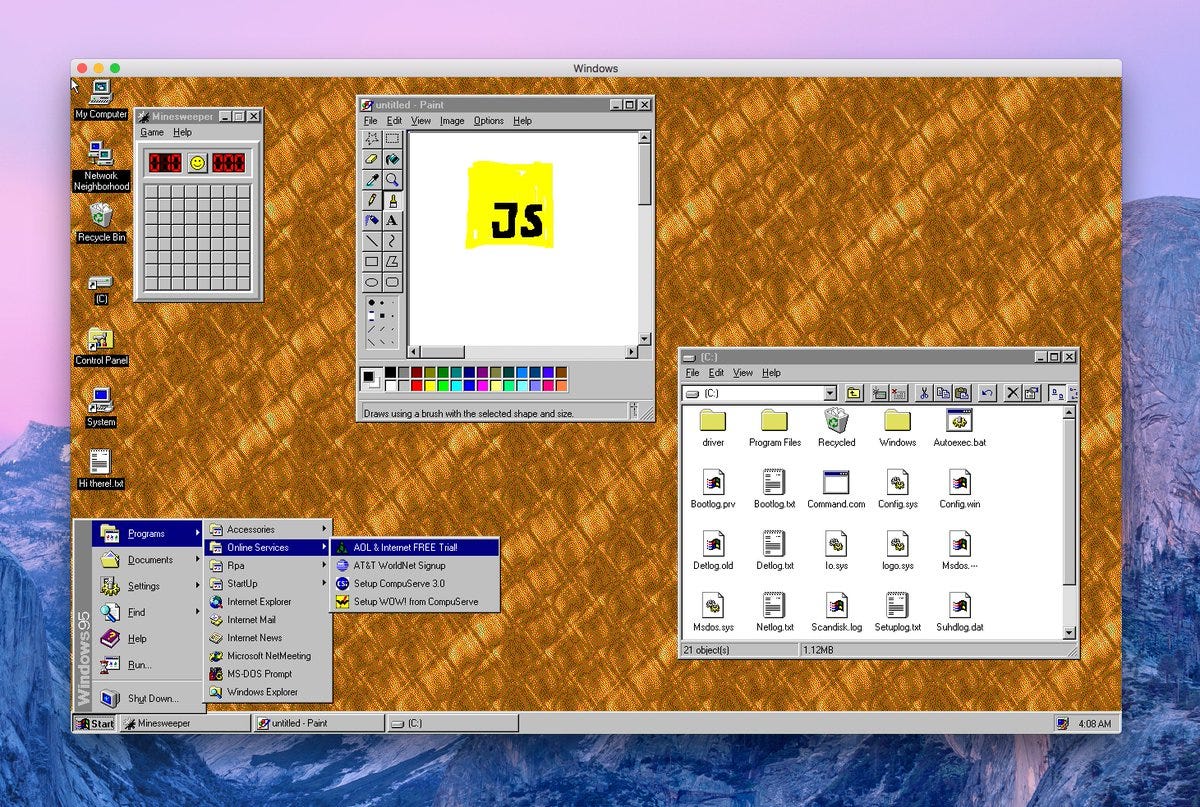
I was going to bring out he's the original machine in the machine guy, because he has the windows, uh, windows 95 project, where's the windows 95 project time?
It's probably someone might get up, right?
No, no, no, no, no, no, no, no, no.
Is it the first thing you see is this one?
No, yes.
Exactly.
That was honestly a very fun project though, like obviously I didn't, I should, I should say this just so they're knowing it's the wrong impression.
I did not write the actual, the actual obviously I didn't build windows 95, because I was a child, but also I did not build the actual engine that is capable of like simulating an x86 processor and JavaScript and wasm, um, that's a tool called V86, which is very cool and everyone should try.
But this came out of, uh, this came out of like a debate we had at work where people were like, they often are in the inter debating the merits of electron and whether or not we should be building software in JavaScript, yes or no.
And I still am very upset that I can run all of windows 95 in JavaScript and launch Microsoft Excel inside the virtualized JavaScript windows 95 machine and do things that I can do that entire chain faster, then they can do a lot of other things like traditional SaaS applications and this is sort of like a like a performance rampage that I've been done.
So I'm mostly built as a joke for some of my colleagues at Slack, this took like one night, which, but then, that I, it was, it was, it was all the hard work is in V86.
Like it's got the reports going to say like 99% of this work is done by a guy who goes after the, by the name copy, his name is Fabian.
Yeah.
Cool.
I think you're, you're kind of back on the windows rhyme because you're building on the windows support.
Uh, I thought there was some really cool technical stories to tell and it gives people an appreciation of like, well, here's how hard it is and here's how important, how, how you invested the sandbox.
So maybe this is like a good opportunity to talk about some of the details.
Oh yeah, the, the VM honestly, it's like so cool.
There's a lot of things we dislike about the VM, right?
Like there's a lot of things that are real trade-offs and you want to know why you're making those trade-offs.
Um, and you're right, there are a lot of people write me like, hey, how come cloud is taking a 10 gigabytes?
I could say on the point, it's not actually taking up 10 gigabytes, just like a way that macOS displays bites, it's like wrong, but the way we actually write it to disk is by we collapse the empty space in the image.
So it's not actually taking up 10 gigs, but that's a technical differentiation that's for not going to happen at all.
To me, the, the, the how come is, it takes too long to start?
Yeah, it's like 30 seconds, so times are, I don't know.
I should be fast on with that.
Whatever.
Well, he's maybe tell about, it feels like 30.
Yeah, like even either way, like whatever it is, it's going to be, it's going to be slower than just running Clark or directly in your computer, right?
So the trade-offs are real.
But what we're doing on Windows, we're using the Windows, Windows host compute system, it's the same thing that WSL tool runs on, like the Windows subsystem fill in X, but I think a lot of developers appreciate quite a bit.
Yeah.
And it's, it's pretty cool because we're sort of like have to separate out, which system space this virtual machine runs in, in who gets to talk that virtual machine, because obviously you give this virtual machine a decent amount of power.
How do we optimize, not just the connection between the two systems, but also how do we make sure that random other application doesn't get to talk to Clark inside the VM?
Hmm.
Would you some pretty interesting things?
Last week, we started writing a new network in service and networking driver that optimizes how Clark talks to the internet.
If your company is doing weird internet things, like the parallel inspection and like the, like, you know, taking your part as a cell and such a company, I think that was probably like a very small, easy version of the build of co-work that is much simpler, but also breaks on most computers.
And this one is quite nice because it works on most users' computers.
And the default example I was going for is, I really want this to be highly effective on a machine that most people pick up.
And that machine will probably not have Python, it will not have no JS.
And even if I just take away those two things, Clark is going to be so much less effective from your computer.
So what do you do?
You don't even, I mean, make, maybe require people to install an old in Python.
Oh, like, you own, like, what is the future, like, like, without a VM?
No, or so, like, like you say, right, let's say our game machine is whatever is a default spec windows that talk.
We do this.
We're just quite cool.
So on on, uh, macOS, we use the Apple virtualization framework, which is pretty solidly optimized.
Like, it's good stuff.
And it's a simple API call, right?
It's just like super simple.
I saw the code recently.
I don't know, like, that's it.
What the fuck?
We do, once you start, like, shipping production code under that you start adding, like, all of these edge cases, you're no good ends up being a little longer.
But, um, I think Apple really cooked with a virtualization framework.
It's very, very good.
It is very fast, it's very reliable.
And the same on Windows, the the host compute system.
I think WSL too, as well, is maybe one of the diamonds with the Windows, it's like one of the few things that developers universally rave about is very, very cool.
And like, hooking into the same subsystem makes a lot easier for us to say.
We don't really care how locked down your computer is.
Maybe it's like your employer's computer and your employer has decided that you get to install nothing, not trusted.
But it's true in a lot of environments, right?
Like even at Anthropic, our IT department controls what kind of software you install, just like a pretty common experience for many companies.
Um, and this gives IT departments a decent amount of, like, it makes their job so much easier.
Because we can say you can separate out, class computer from the user's computer.
And then for class computer, where you probably care about this data loss, you care about, like, a potentially hostile actor, you care about maybe data being exfiltrated.
And once you control the network and the file system layer, you don't really care necessarily anymore.
The club might be writing super digital Python scripts.
What worries you about the fact is that like once you install Python, now anyone can do anything on the computer.
For once you put that in a VM, that risk really goes down.
Yeah.
So that's why we jumped through all of these loops.
Yeah, I think you had a different tweet about this.
But it's almost like, people have also approved exhaustion.
Like, it's like, you can't approve every single commands.
Like, sometimes by default, some of the CLIs, I think even early cloud code, we have to approve every single command.
Yeah.
And like, it's a, there's this sort of dichotomy between either approved every step or dangerous these good permissions.
Yeah.
And actually sandbox things, like, kind of like the middle ground.
Yeah.
I do think, I do think it's maybe on us, it's like the industry to come out something better than, oh, this is super safe as long as it doesn't do anything.
Right.
If you want this to be useful, then you have to like approve every single step of the way.
And like computer uses a good example.
The only way to make computer use on your host, like super safe, like really super safe, is probably if you approve every single action, right?
Like models like I would like to type the word L.
You're like, okay, that seems fine.
Yeah.
I know.
I know which like cursor is focused.
Yeah.
It's not automation.
If you don't delegate.
Yeah.
Exactly.
You need to probably delegate.
You need to be able to like delegate and walk away and trust that this thing is not going to like mess automatically.
And I don't even think we need to build perfect systems.
I don't think we need to wait for like 100% model alignment.
We can rely on the same Swiss cheese model with use in the industry for a long time.
But do you think we need to like universally maybe eventually invest more?
And that's what we do.
We need to invest more in systems.
But we can say you do not need to approve everything.
Speaking of Swiss cheese model.
I mean, he just wrote a thing about this.
How cool.
Yeah.
Yeah.
Yeah.
Super cool.
I mean, yeah.
It's weird how like, I guess usually I think safety and security is kind of like a boring word to to engineers.
They're like, this can be unsafe to me.
Unsecure.
But I think achieving the right thing.
Like you're going after a consumer slash pro-sumer.
Yeah.
Trying to go out.
I was kind of like both.
I think I also want to capture people who would have no trouble using cloud code like yourself.
Yeah.
Yeah.
But still find them maybe just convenient easier.
You're like, oh, cool.
That's like the drillists on the right.
I can edit it.
Those things are just easier to do if you have to.
Yeah.
But this is like clearly the knowledge works side.
Yeah.
Cloud code will clearly capture the development workflow.
But like I do think like you have to sweat this like safety and security details in order for people to trust it.
And like the even clouding Chrome like having the whatever API uses to do the background thing.
Yeah.
That's the only reason I use it because otherwise I would have to just get a separate machine.
Yeah.
And just run it run it.
That sounds so super annoying.
Yeah.
I mean, I can't really do it.
But I think also as developers maybe where we are more risk tolerant, but we're also just like accepting, we are more risk tolerant.
But I think we also just have like, I don't want to say arrogance, but like sort of the trusted of like the really bad thing happens.
We can probably fix it.
I just tell Cloud to like, I check with me before doing any irreversible action like sending an email or do that.
Yeah.
It's good enough.
But like not even cloud.
I mean, like a simple thing such as in PM install.
And like we're all running in PM install with full user permissions.
And if it wants to like read.
SSH it will crazy that that is the default.
Kind of, yeah.
I know I agree.
I agree at the time.
Like I'm obviously doing it every single day.
No, right?
Like I think obviously, PM can get up to have like done a pretty good job.
Maybe over the last couple of months to like clean house and come up with like more specific tokens.
But generally speaking, I think it's engineers.
We've always been a little bit more risk tolerant.
And if you do a little bit of introspection and you ask yourself, is that how we should be doing things?
You might not always come up with a right answer.
And I think from models to like my approach, like I'm not going to the safest thing is to do nothing.
We do one products that are quite capable.
But to the extent possible, I don't want to ask you, are you okay with a script?
Because I kind of believe that once it's supposed to be coming up out of your workflow, you're probably not either either you don't have the skill to understand whether or not this Python script is safe or you're not going to read it anyway.
Cool.
I guess a couple parting questions.
What's the future of clock work?
I think we still were still such early days.
We're going to keep shipping things that we're going to keep shipping things that we're going to keep iterating of the same like pretty quickly, but which I mean, you can sort of continue to expect that every single week that's going to be like a small new feature, if not a big new feature.
I'm going to continue probably to double down on your computer and like making you a factor from your computer and making cloud effect of your computer.
We're starting to grapple as we talked about today, grapple more with a cluster of like what does it mean?
What does your computer mean?
Does it have to be the one in front of you or like a VM on your computer or like a computer somewhere else?
And then the third thing that I'm quite excited about is we're continuing to go up this hill climbing on slowly taking users who are used to asking questions and getting an answer to slowly to do them to like step more and more away and that clock take over like bigger and bigger tasks and work both in time as well as in like scope.
And I think you can probably see most of the hour investments on our feature releases like working both those things like the ability to do more on your computer and then the ability to do more independently and for longer.
There's remote control work for clock work yet?
No right.
Excellent question.
Coming soon.
I mean that's an obvious thing if you want to keep betting on your computer.
But to me like you know we talk about like people are not ready this year like there's no wall it's exciting to me like what will be we be doing differently at the end of this year that you know we may be not even thinking about this at the start of this year right like I'm just trying to look ahead as to like what's like a good use case that you're with it was sort of aimed towards.
So for example for the machine learning scientists it's always okay well I want AI scientists they can automate at the automated machine learning but like for knowledge work I mean I can already you know get it to sign up for Google Cloud to mean as a GI because Google Clouds but like what is what's beyond that I don't know.
I think it's basically the idea that like you still have to tell her to build your script right you were still kind of involved.
Yes and maybe a way that fell kind of magical to you but like maybe between the other side is the person building this product still feels kind of heavy-handed.
I see so much process that I'm like oh let me take that away from you.
Okay like how do I just go I will continue to go we'll continue to go like further and further up the stack and make your life easier and easier.
Oh here's one right yeah watch I you know I don't care about my own privacy whenever or I trust I trust in Thorpec so just watch everything I do on a normal day-to-day basis at the end of the day tell me what you is hardcore workable.
Yeah I don't know.
I think the funny thing about a lot of these products is that like for good reason I don't enjoy I don't feel my entire career I've never like teased too much what I'm working on because I think you should just like yeah to lose it yeah build the days and release it and then talk about it like I'm not a big fan of that like vague posting around work ahead of time.
Yeah but the thing that is like always so fascinating to me is both of you are multiple times a day you've like mentioned things and like yeah that is obviously like very obvious okay that someone should be working on those things and I think we're still in the space where if you look at co-work the things that we will be releasing will probably not be a big surprise to either if you're going to be like yeah obviously that's valuable.
Obviously they were working on those things yeah and obviously that's good and useful and the more I hit those points the more our features fit into that category I think the better it is for us because then we don't end up building things that are dual hyperspecialized to a difficult time instead.
Yeah I think the hyperspecialized thing is very important.
It keeps you like general purpose when it means you're not thinking too small maybe I don't know what the word is.
Yeah exactly it's like the whole concept that like a no-point if we release you know there's no claw code for no jazz applications that use reactant tends to act and only those two things and like if it's anything else I know several startups like that.
I think that's pretty like I'm not a VC I'm not an investor it's like hard for me to predict where the markets go but in terms of the building box that I'm interested in.
The electron is probably by far the most popular thing I ever built and electron itself is like very extractible and generalizable right?
So many apps running it I think it would have been hard for me to predict how many apps actually end up using electron yeah and what would have been even less useful for me to predict this in what those apps I just really remember Bloom coming out of being that is cool like you're a camera in a little circle in the corner and that is pretty smart that's an electron app yeah yeah or at least well as I'm not sure if it's still the same it was for a while.
I like one part so that's so many interesting things right?
It's it's it's an level of the stack that I'm quite comfortable with and whenever I give out the engineers it buys it's actually that layer that I think is most valuable to invest in because the tools of the layer are not that good but that's where you get the most leverage for the future and general just quick tangent on electron because I always wonder is have you looked at Tori?
I have yeah what's your take you know my my my my view is like most things should be Tori by default unless you really need the full power of electron but yeah I can give like my take on I can give my big take.
Why do we ship an entire version of Chromium inside the thing right like what do we do that and people ask me this question a lot because it's like very counterintuitive wouldn't it be much easier to use the values that are on the operating system wouldn't it be much easier not to have to do that and the answer is yes and obviously I did that once upon a time I did that was a version of the slackout that used just the operating system that feels we did you did you start the slackout?
I would well team effort and yeah yeah but I was I was there and we built the slackout yeah it's crazy um I mean obviously get the electron guy to do it but well but this is an interesting fine like by the time by the time I joined Slack they already had an app that was built with something at the time called Mac app it was a little bit like the same app got thing for a mobile it just used the operating systems that feels um and that didn't work for like so many reasons um and they were like all right maybe we need like bigger guns we need to like take more control of the rendering stack and there's there's a few things I was mentioned here um I think if you building a small app just going with the operating systems that feels perfectly fine if you building an app maybe that doesn't have too many users who will like cry bloody murder if it doesn't work that is fine the reason to go with your own embedded rendering engine is because and this is still true in 2020 60 operating system rendering engines are not that good and just not that good both Microsoft and Apple are trying to move away from that they so far have really haven't the only way to upgrade those is to upgrade your operating system so if you're a sales lag and you have critical rendering bug in wkvpu and some of the other vpu options you're only recourse is to tell your customer oh sorry you're too poor you didn't buy the latest MacBook are unacceptable unacceptable to use or unacceptable to use a developer so you sort of need to like go down the stack and like find the best rendering engine then put it in your app why chromium even though it's very big chromium is by far the best thing like I often like to remind people the Unreal engine when a vendor is some text they use chromium like chromium is part of the Unreal engine for same purposes chromium is very very good I think it's like one of the marvels of engineering it's very hard from where it's have a Cisco right out of the recording most of the people in the city are vip developers it's hard for me to like overstate how magical it is they can once eat like rendering a YouTube video dynamically negotiating a bit rate figuring out what to do about your extremely broken hotwood driver actually this is a fun thing um you can enter chrome colon whack-wack GPU okay and if you scroll down a little bit these are all the enabled workarounds because something is going wrong on your computer if you're doing this on a Windows computer with like a GPU that is not the most popular GPU it will be much longer and all of these are usually just there to make sure that if I say as a developer I want a red pixel to appear here that that actually happens chrome is such a marvel because of works on all the machines that use on my throw deal and it's going to work fairly reliably and if it doesn't they will probably fix it within 24 hours I see so this is the super operating system right there it works everywhere yeah all right yeah yeah yeah so a lot of the magic of electron is honestly just that it makes it very easy for you to ship chromium in a way that serves you exactly in your use cases electric exactly our next interview is with Mark and Jason yeah who had the phrase like desktop OS's are just poorly deep uh poor implications of the actual OS which is chrome which like actually works everywhere it is this is the platform where you ship apps I think the wild thing is that I guess engineers were so often sort of assumed that the platform like the label OS is like super stable and they talked to those people that I got we are also just like guessing um and I had like a distinct moment at Slack where one of our customers at Slack was in video and for a while I really put GPU developers on this pedestal in my head and I do think they're still probably much smarter than I am but I was like hard engineers who built the chips and then they built the driver's their work must be so much harder than mine they must be very good and we had like one bug and Slack well like if you had a YouTube video in Slack I wouldn't quite render why like what have this weird artifact and then I'm there being a chromium back and ended up on this like giant thread so I got to see a lot of the source code and they also are just like common to do we don't know why this is weird but if you flip this bit things work you know this is just like having it ever layer of the stack maybe the uh you know the end of year a geoproduction is that clock and build chromium you see you you laugh now but yeah you know someday it's it's done you can get pretty good like it used to be completely useless um mostly just like overwhelmed both with the whole hyper specialized tools are inside the chromium repo like for for a long time the chromes are like sort of reinvent of the tools because none of them were capable of ending chrome I think the igi moment I'm kind of waiting for is at what point I'm gonna say electron is probably holding a necessary because you can just build fully native apps the Swiftie yeah like not just in Swift because this is one thing like it's pretty easy if you I think our current models are quite capable of taking an electron app and replicating its Swift are they gonna be capable of like building an app that is actually more performant which is less memory all of that stuff um here's gonna go onto the same hyper optimization that developers have done for a long time we're not quite there yet work and like coin even our best models at a thing and say just replicate this in native code make normal mistakes ultra think right we're not quite there yet um not just think it's better today or think it's back it has okay or we'll give it an actual thing for like days just a pretty long time for boredom but he worked on ultra think for days yeah why just it's just a prompt I let it a little bit more goes into yeah okay another question I had is like co-works so if I have my clogged co-work like what's kind of like the multiplayer mode I think sub-agents is like single players split up the context yeah and the multiplayer co-work is like my colleague has some file on their machine that I want to know about or I want to know how their task is going to then update my thing like is that interesting is that something that makes sense for you to build or for like it's like super interesting to me it it almost goes back to like some of the scaffolding where I'm like okay are we gonna be end up are we will be end up building scaffolding they will just go away and like a question I have here is at what point do we just assign these things like their own Gmail account we'll just give them their own like Slack handle and then they will just like use the same tools we humans use to interact with each other you mentioned our finance people they've been working pretty hard on very good office integrations and I think for a while we build so much tech around cloud leaving useful comments that's at a Google Doc and now just does it just like leaves a common in a Google Doc and that's how you interact with it maybe like the similar thing where I still have open quest treasure on what is the best interaction mode is it for us to build something super custom for co-work agents to talk to each other or is it okay let us jump straight to the finish line and say well we're just gonna give this thing if you use Slack at work we're just gonna give this thing a Slack handle and that's going to be the way it's like multiplayer capable big community with each cutter yeah like you know as it's as a fun project I build this thing called PiQ which busy takes any repo and the Pi agent coding agent it puts it in a VPS and then there's a public web hook where anybody can submit a coding task oh then there's a dashboard in which you review the task I'll just like you Pi Pi Q yeah you busy get all these like tasks anybody can submit a task and to me it's almost like in the organization of the future it's like the sales people are talking to the engineering team that is talking to the marketing team to the product team and all these co-work are going to like queue up decisions for other people to approve in a way yeah you know and I'm kind of curious what that looks like and like how do you how do I give my co-work the ability to build a proof task without asking me yeah and how do this I which one I need to review yeah because for some of these things is like you know you want to change the color or something that's kind of like a branding decision or another one is like hey your thing is just broken it's like this is like how you fix it yeah cloud can actually review but or not that prompt matches what is trying to do today everything is still very it's like multiplayer with them the single player you know I get up and up many of them but like how do I get multiple people to hand off to each other things using their particular context yeah and for both of your co-work select talk to each other right right yeah hey we got an episode today can you like have you you know or yeah this is like a uh I know we like running out of time here but like we we previously talked about sharing skills and I did have this question of like what if your co-work which is like ask the other co-works if they have a skill for this task doesn't know who these could do all right like okay so skill transfer yeah like um and again this maybe if the DP this maybe goes back into the territory of like building something very powerful and building something creepy often goes hand in hand um because I could tell from the reaction that my fellow engineer said that this is probably not what we're going to do but like we have Bluetooth LED right like I this computer can figure out that it's sitting right next to this computer so you're probably working on the same thing um well you see that in co-work probably not but um there's like I think really creative solutions to problems that we really haven't tried yet yeah excellent I guess the the last thing is the anthropic labs I always have this mental model of a model lab versus agent lab and this is basically anthropics internal agent lab which co- co-card code uh is now under eyes part of the whole org I mean people are still fungible right like okay this is just yeah I don't know how I don't know how real this is I don't know no it's a real team it's um the the last team is primarily working though on things that you don't see in public yet yeah um the trying like really wild out there ideas that seem quite improbable um the mad saying say but you you're you're officially under this thing or now we're getting worse if a blog code is been let then now blog code is like a fairly big group where I actually know many people we are like like I remember yesterday coming into our weekly co-work meeting I was like woo this is a lot of it but we still have a lab team and we actually made the labs team a lot bigger Mike just joined the lab team as an I see which I think is very cool and very fun but they're they're working on things that you have not seen yet that are extremely out there and probably half broken right like these sort of the idea of a lab team is that it should only work on things that make really no sense for anyone else to work on okay well looking for exciting things from there but thank you so much I know we're out of time but uh appreciate you're joining us I appreciate cloud core everyone go use it it is the closest I felt to each item is here let's somehow do you to say thank you very much yeah thank you for your time yeah